
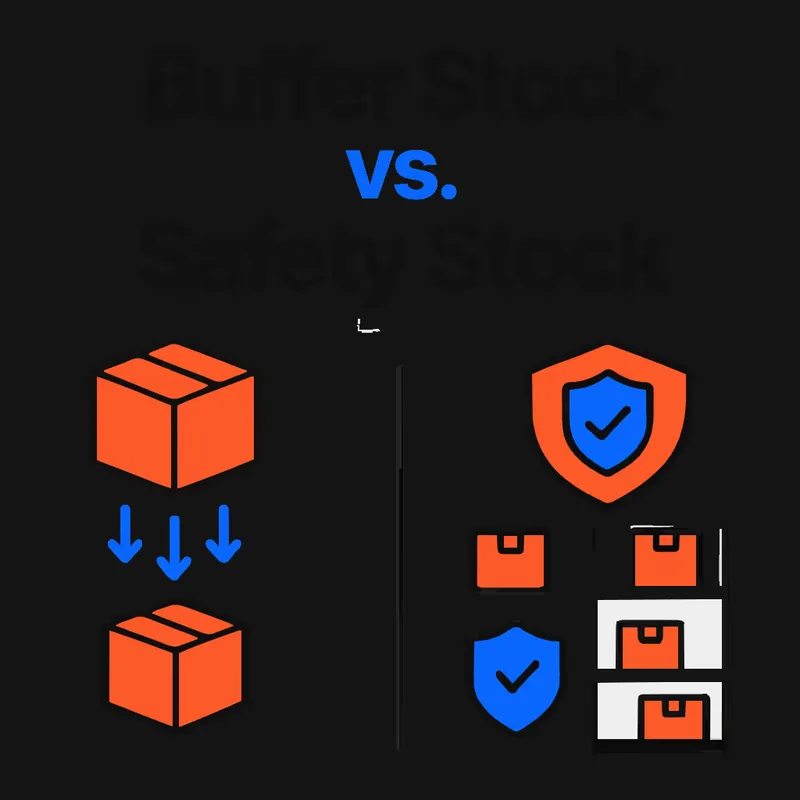
Buffer Stock vs. Safety Stock: Understanding the Key Differences
Buffer stock manages internal flow variations while safety stock guards against supply disruptions. Learn the formulas, when to use each, and how they work in Kanban systems.
In the world of inventory management, two terms are frequently confused: buffer stock and safety stock. While they both involve holding extra inventory, their purpose, calculation, and strategic use are fundamentally different. This confusion is not semantic. It leads to overstocked shelves, tied-up capital, and preventable stockouts in manufacturing.
This guide provides a clear, practical breakdown of buffer stock vs safety stock. We'll define each concept, highlight their key differences in an easy-to-understand comparison, and show you exactly how they function — especially within lean systems like Kanban — so you can optimize your inventory strategy and achieve both excellent customer service and efficient operations.
Key Takeaways
- Safety stock protects against external surprises like supplier delays and unexpected demand spikes, while buffer stock manages internal process variations to maintain smooth operational flow
- Safety stock is your "insurance policy" that sits unused until emergencies, whereas buffer stock actively cycles through normal operations like water in a reservoir maintaining steady flow
- Use different calculations for each: Safety stock uses statistical formulas based on demand volatility and service levels, while buffer stock uses simple maximum vs. average usage formulas
- Both work together in Kanban systems — buffer stock handles downstream demand variations while safety stock protects against supply-side disruptions
- Misunderstanding these concepts costs money: Overestimating buffer stock ties up capital unnecessarily, while underestimating safety stock risks stockouts and customer dissatisfaction
- Start with critical items first when implementing your strategy, then expand to other categories while continuously monitoring stockout frequency, carrying costs, and customer satisfaction metrics
At a Glance: Buffer Stock vs Safety Stock Comparison
To make the distinction crystal clear, here's a side-by-side comparison of the core differences between these two essential inventory management concepts:
| Feature | Safety Stock (The Insurance) | Buffer Stock (The Shock Absorber) |
|---|---|---|
| Primary Purpose | Prevent stockouts due to external uncertainty | Maintain smooth operational flow despite internal variability |
| Problem Solved | Unexpected demand spikes & supplier delays | Normal variation between process steps |
| System Context | Used in most inventory models (traditional & Lean) | Core strategic element of Lean & Kanban systems |
| Best Analogy | Spare tire in your car | Water reservoir or highway merge lane |
| Inventory Type | "Just-in-case" protection | "Just-in-time" enabler |
| Focus Area | External factors (market, suppliers) | Internal factors (production line, cycle times) |
| Usage Pattern | Rarely touched, emergency use only | Actively cycled through normal operations |
| Calculation Basis | Statistical demand volatility & service levels | Process cycle time differences |
| Risk Management | Guards against supply-side uncertainties | Manages demand-side variability proactively |
This comparison reveals why treating these inventory types as interchangeable can create significant problems. Overestimating buffer stock results in tied-up capital, higher storage costs, and risk of obsolescence, while underestimating safety stock risks missed orders, emergency replenishment costs, and ultimately customer dissatisfaction. Each serves a distinct strategic purpose in building a resilient yet efficient operation.
What Is Safety Stock? The Ultimate Insurance Policy
Safety stock is extra inventory held specifically to protect against unexpected or unpredictable variations in supply and demand that occur outside your normal operations. It's your contingency plan for when external uncertainties threaten to disrupt your ability to serve customers — think supplier delays, demand spikes, or quality rejections.
The primary purpose of safety stock is stockout prevention when faced with situations you simply cannot predict or control. These situations include unexpectedly high customer demand that exceeds your forecasts, unreliable supplier lead times that stretch longer than anticipated, or unexpected quality issues from suppliers that force you to reject entire shipments.
Here's a perfect analogy: safety stock is like the spare tire in your car. You don't use it for daily driving — it sits there unused most of the time. But when you get a flat tire (an unexpected external event), that spare tire prevents you from being completely stranded. Without it, one unforeseen problem could bring your entire journey to a halt.
How to Calculate Safety Stock
The calculation of safety stock typically involves analyzing historical demand volatility and lead time variation using statistical formulas that account for your desired service level:
Safety Stock = Z × σ × √LT
Where:
- Z = service level factor (e.g., 1.65 for 95% service level)
- σ = standard deviation of demand
- LT = lead time in days
This formula reflects random demand-supply fluctuations outside normal process control. For a deeper walkthrough with step-by-step examples, see our guide on how to calculate safety stock in Kanban.
Example: If your maximum daily sales are 100 units with a maximum lead time of 7 days, and your average daily sales are 60 units with an average lead time of 5 days, your safety stock would be 400 units. This ensures you can handle the worst-case scenario of high demand coinciding with long lead times.
What Is Buffer Stock? The System's Shock Absorber
Buffer stock is a strategic amount of inventory used to proactively manage variability between connected processes, acting as a shock absorber that maintains smooth, continuous operational flow. Rather than guarding against external surprises, buffer stock ensures that naturally occurring differences in process speeds don't create bottlenecks or idle time.
Buffer stock does prevent stockouts, but its primary goal is maintaining operational flow and efficiency. This makes it a core component of Lean and Just-in-Time systems, where smooth flow is paramount to eliminating waste and maximizing productivity. Understanding how buffer stock enables pull-based inventory management is essential for any manufacturer adopting lean principles.
Buffer stock comes into play during normal operational situations: slight differences in cycle times between two connected workstations, planned changeovers or routine maintenance windows, and normal, minor fluctuations in operator speed or material availability. These aren't emergencies — they're predictable variations that occur in any real-world production environment.
Think of buffer stock like the water in a reservoir behind a dam. The reservoir "buffers" inconsistent rainfall (your inputs) to ensure a steady, predictable flow of water through the turbines (your process), generating consistent power output. Without this buffering capacity, every variation in rainfall would create chaos downstream. The reservoir doesn't exist because of emergencies — it exists because natural variation is inevitable and must be managed.
How to Calculate Buffer Stock
Buffer stock calculation uses a straightforward formula based on known maximums and averages:
Buffer Stock = (Max Daily Usage × Max Lead Time) − (Average Daily Usage × Average Lead Time)
This formula quantifies the inventory needed to buffer internal process timing differences effectively.
Example: If your cutting station produces parts slightly faster than your assembly station can consume them, you maintain a small buffer stock of cut parts between the two stations. Say your max daily usage is 150 units with a max lead time of 10 days, while average daily usage is 100 units with an average lead time of 7 days. Your buffer stock = (150 × 10) − (100 × 7) = 800 units. This decoupling inventory ensures your assembly workers never wait for parts, maintaining continuous flow.
The Importance of Stockout Prevention
Inventory stockouts in manufacturing are incredibly damaging. They create immediate revenue loss, damage customer relationships, and can permanently harm your brand reputation. In fact, research suggests that stockouts can damage customer trust far beyond the immediate lost sale.
The cascading effects of stockouts include:
- Immediate Sales Loss: Every customer who can't buy your product represents lost revenue that may never be recovered
- Customer Defection: Disappointed customers often switch to competitors and may never return
- Brand Reputation Damage: In the age of social media and online reviews, stockout experiences can quickly become public criticism
- Operational Disruption: In manufacturing, stockouts of critical components can shut down entire production lines, creating costly downtime
Leveraging Both Safety and Buffer Stock
The most effective approach to stockout prevention combines both buffer stock and safety stock strategies. This dual approach covers both demand-side surprises and supply-side disruptions.
By implementing both strategies thoughtfully, you create multiple layers of protection that can handle various scenarios simultaneously. For instance, during a promotional period (requiring buffer stock), if your supplier also experiences delays (requiring safety stock), you're protected on both fronts.
Buffer Stock and Safety Stock in the Kanban System: Optimizing Flow and Efficiency
The Kanban system represents an inventory management approach using visual signals that trigger replenishment based on actual consumption rather than forecasts. This "pull" system creates efficiency by producing and ordering only what's needed, when needed.
Even in this highly efficient system, both buffer stock and safety stock play crucial roles in maintaining smooth operations and handling real-world variability.
How Buffer Stock Enhances Kanban Performance
In Kanban systems, buffer stock serves a specific downstream function: covering variations in demand from downstream customers or processes, ensuring the system continues operating smoothly despite fluctuations in consumption rates.
When customer demand fluctuates, buffer stock prevents the Kanban system from experiencing immediate shortages while replenishment signals work through the system. Key applications include:
- Demand Rate Variations: When downstream customers increase consumption rates, buffer stock prevents immediate Kanban shortages while replenishment signals propagate through the system
- Consumption Pattern Changes: If customer ordering patterns shift — perhaps ordering larger quantities less frequently instead of smaller quantities more frequently — buffer stock smooths these variations
- System Flexibility: Buffer stock provides flexibility allowing Kanban systems to handle promotional periods or seasonal demand increases without requiring complete system recalibration
Safety Stock's Critical Role in Kanban
Safety stock in Kanban systems addresses supply-side protection: it guards against volatility in supplier lead times, potential quality issues with delivered parts, or unforeseen production stoppages.
Even the most efficient Kanban system faces disruptions from supplier variability, and safety stock provides necessary cushioning. Key applications include:
- Lead Time Variability: When suppliers experience delivery delays, safety stock ensures Kanban cards continue triggering replenishment without creating stockouts
- Quality Issues: If incoming materials fail quality checks, safety stock provides alternative inventory while issues are resolved with suppliers
- Supplier Reliability: For critical components from less reliable suppliers, safety stock ensures the Kanban system maintains pull signal integrity
Calculating Kanban Requirements with Stock Considerations
Modern Kanban calculations incorporate both buffer stock and safety stock considerations to ensure system resilience. The number of Kanban cards or bin sizes reflects not just average demand and lead times, but includes buffers for both demand and supply variability. Understanding how to set your kanban reorder point correctly depends on getting these stock levels right.
Key Kanban calculation factors include:
- Average daily demand and consumption patterns
- Supplier lead times and delivery reliability
- Demand variability requiring buffer protection
- Supply uncertainty requiring safety protection
- Container sizes and handling constraints
Dynamic digital Kanban systems can adjust these stock levels based on real-time data, optimizing inventory while maintaining system reliability. Tools like Arda Cards make this process straightforward by automatically tracking consumption data and signaling when stock levels need attention — giving manufacturers real-time visibility without complex ERP implementations.
Common Mistakes in Buffer Stock and Safety Stock Management
Even experienced inventory managers make errors when implementing buffer and safety stock strategies. Here are the most frequent pitfalls and how to avoid them:
Overestimating Buffer Stock
The mistake: Setting buffer stock levels based on worst-case demand scenarios rather than normal operational variation. This ties up working capital and increases carrying costs without meaningful protection.
The fix: Base buffer stock calculations on actual process cycle time differences, not demand forecasts. Review and adjust quarterly based on real consumption data.
Underestimating Safety Stock
The mistake: Using average lead times and average demand to calculate safety stock rather than accounting for variability. This creates a false sense of security that collapses during the exact disruptions safety stock should cover.
The fix: Use the standard deviation-based formula (Z × σ × √LT) and factor in your actual lead time variability. If your supplier delivers in 5-14 days, your calculation must account for that full range.
Treating Them as Interchangeable
The mistake: Using one combined "extra inventory" number instead of calculating buffer stock and safety stock separately. This leads to either over-protection in one area and under-protection in another.
The fix: Calculate each independently based on its specific purpose. Buffer stock addresses internal process variation; safety stock addresses external supply uncertainty.
Failing to Recalibrate
The mistake: Setting stock levels once and never revisiting them. Demand patterns shift, supplier reliability changes, and production processes evolve — static stock levels become increasingly misaligned with reality.
The fix: Review buffer stock levels monthly and safety stock levels quarterly. Use actual stockout incidents, inventory accuracy data, and carrying cost trends to guide adjustments.
Implementing Your Buffer and Safety Stock Strategy
Now that the distinct roles of buffer stock and safety stock are clear, effective implementation requires careful planning and ongoing optimization. This is especially important for manufacturers managing variable consumption goods — items like abrasives, adhesives, and cutting tools where usage patterns are inherently unpredictable.
Assessing Your Inventory Needs
Start by analyzing current inventory challenges through two analytical lenses:
Demand Analysis for Buffer Stock:
- Review historical sales data for demand patterns and spikes
- Identify seasonal trends and promotional impact periods
- Analyze customer behavior changes and market influences
- Evaluate the cost of lost sales during high-demand periods
Supply Analysis for Safety Stock:
- Assess supplier reliability and delivery performance
- Review lead time variability and shipping challenges
- Identify critical components that could disrupt operations
- Calculate the cost of production delays or shutdowns
Building Your Implementation Plan
Create a phased approach that allows testing and strategy refinement:
- Phase 1: Critical Item Protection — Focus on your most important products or components first. These might be highest-revenue items for buffer stock or most critical production components for safety stock.
- Phase 2: Category Expansion — Gradually extend buffer stock and safety stock strategies to additional product categories, learning and optimizing as you progress.
- Phase 3: System Integration — Integrate stock strategies with your broader inventory management systems, including demand planning, supplier management, and customer service metrics.
Monitoring and Optimization
The most successful buffer stock and safety stock strategies evolve continuously based on real performance data. Track these key metrics:
- Stockout frequency and duration — Are stockouts decreasing over time?
- Customer satisfaction during high-demand periods
- Inventory carrying costs and turnover rates
- Supplier performance improvements or deterioration
- Sales capture rates during promotional periods
Regular reviews allow stock level adjustments, calculation refinement, and overall inventory management effectiveness improvement.
Frequently Asked Questions
Is buffer stock the same as safety stock?
No — though they're often confused, buffer stock and safety stock serve different purposes. Safety stock is extra inventory held to protect against unexpected external disruptions like supplier delays or demand spikes. Buffer stock is inventory maintained between process steps to absorb normal internal variations in production speed or cycle times. Safety stock is your emergency reserve; buffer stock is your operational flow enabler.
How do you calculate buffer stock?
Buffer stock is calculated using: (Max Daily Usage × Max Lead Time) − (Average Daily Usage × Average Lead Time). For example, if your max daily usage is 25 units with a max lead time of 14 days, and average daily usage is 15 units with an average lead time of 10 days, your buffer stock = (25 × 14) − (15 × 10) = 200 units.
What is the difference between cycle stock, safety stock, and buffer stock?
Cycle stock is the inventory consumed during a normal replenishment cycle — it's your working inventory that gets used and replenished on a regular schedule. Safety stock is additional inventory beyond cycle stock that protects against supply-side uncertainty (late deliveries, quality issues). Buffer stock is inventory placed between production stages to absorb timing differences and maintain flow. All three serve different strategic functions in an inventory management system.
When should I use buffer stock vs safety stock?
Use buffer stock when you have connected processes operating at different speeds — for example, between a fast cutting station and a slower assembly station, or to smooth seasonal demand fluctuations. Use safety stock when you face supply-side uncertainty — unreliable suppliers, long or variable lead times, or quality variability. Most manufacturers need both: buffer stock for internal flow and safety stock for external protection.
How does safety stock work in a Kanban system?
In a Kanban system, safety stock is built into the Kanban card quantity or bin sizing to account for supplier variability. When a supplier delivers late or materials fail quality inspection, safety stock prevents the pull system from breaking down. The Kanban signal still fires at the reorder point, but the safety stock cushion keeps production running while replenishment completes.
From Terminology to a Smarter Inventory Strategy
The distinction between buffer stock and safety stock represents more than a semantic difference — it reflects fundamentally different approaches to managing uncertainty and optimizing flow in your operations. Safety stock serves as reactive protection against external uncertainties beyond your control, while buffer stock provides proactive management of internal process variations you can predict and plan for.
Understanding this difference forms the foundation of intelligent inventory optimization. When you apply safety stock to guard against supplier delays and demand spikes, while simultaneously using buffer stock to smooth internal processes, you create an efficient operation that handles both external surprises and internal variations.
The most successful inventory strategies embrace both concepts strategically. By maintaining appropriate safety stock where external uncertainty threatens service levels, while implementing buffer stock where internal process variation threatens flow efficiency, you achieve the dual goals of excellent customer service and lean operations.
Your next step: evaluate your current inventory through this new lens. Identify where you're addressing external uncertainty (requiring safety stock) versus internal process variation (needing buffer stock). This clarity will help you optimize inventory levels, reduce carrying costs, and improve both operational efficiency and customer satisfaction.
Ready to gain full control over your inventory levels and turn this understanding into actionable results? Explore how Arda Cards helps manufacturers automate reorder signals, track real-time consumption, and eliminate stockouts — without the complexity of a full ERP implementation. You can schedule a call to see how it works for your specific operation.
Make the first replenishment loop visible.
Generate free Kanban cards for the parts that most often stop production.
Make Free Kanban CardsRelated reading

OEE for Manufacturers: How to Calculate and Improve Overall Equipment Effectiveness
Learn how to calculate OEE in manufacturing with the exact formula, a worked example, Six Big Losses breakdown, and practical steps to improve your score.
Jul 13, 2026Read article
Takt Time vs. Cycle Time vs. Lead Time: A Manufacturer's Guide
Learn how takt time, cycle time, and lead time work together to eliminate bottlenecks and boost throughput. Formulas, examples, and improvement strategies inside.
Mar 20, 2026Read article
Inventory Turnover Ratio Formula: How Manufacturers Measure Inventory Efficiency
Learn the inventory turnover ratio formula, how to calculate it with a real manufacturing example, and what a good ratio looks like for your shop floor.
Jul 8, 2026Read article