
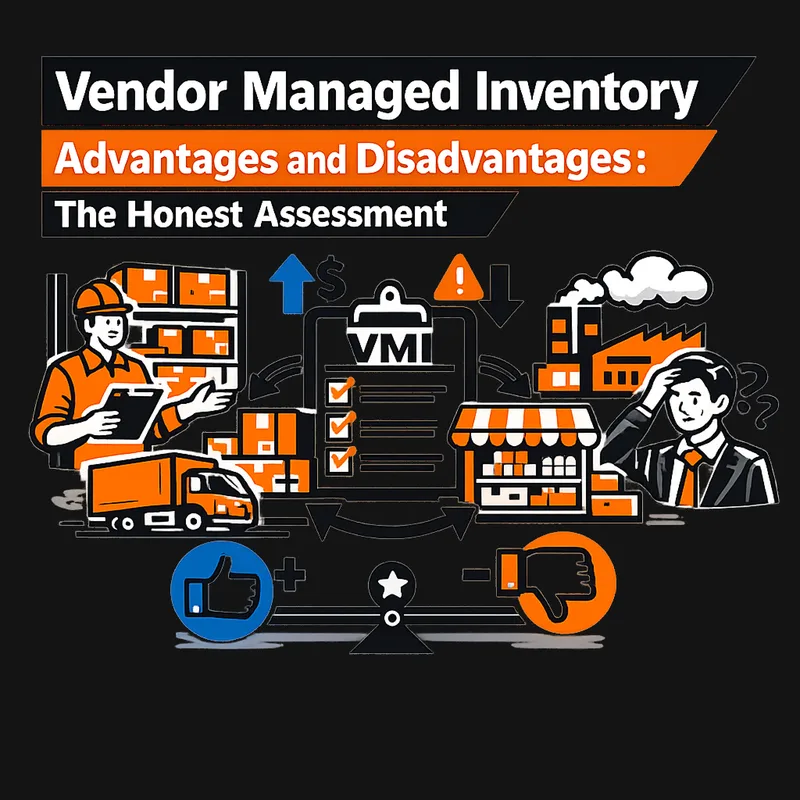
Vendor Managed Inventory Advantages & Disadvantages [2026]
Vendor managed inventory advantages and disadvantages for manufacturers. Honest breakdown of VMI costs, vendor lock-in, and which companies should skip it.
Only about 5% of manufacturer-supplier relationships use vendor managed inventory, despite decades of proven results at companies like Walmart and Toyota. That gap between VMI's potential and its actual adoption tells you something important: the model works, but not for everyone.
Understanding the full picture of vendor managed inventory advantages and disadvantages is critical before you commit your budget, your data, and your supply chain to a model that is genuinely difficult to reverse. VMI delivers real benefits for the right operations. It also creates vendor dependency, technology costs, and control trade-offs that most VMI guides gloss over.
This article provides an honest, data-backed assessment of both sides. If you are still building foundational knowledge about VMI, start with our complete vendor managed inventory guide for a full overview of how the model works. If you are here to decide whether VMI is right for your manufacturing operation, this is the evaluation you need.
Quick Summary: VMI Advantages and Disadvantages
/
The Advantages of Vendor Managed Inventory
VMI's benefits are well-documented and, when conditions align, genuinely valuable. Here is what the data supports.
Reduced Stockouts and Production Downtime
The most immediate VMI advantage is keeping materials on the production floor when you need them. When your supplier monitors consumption data and manages replenishment proactively, they can identify declining stock levels before your purchasing team does.
According to Inbound Logistics, manufacturers implementing VMI commonly reduce stockout rates to below 0.1% annually. One automotive parts manufacturer implemented VMI for fastener inventory and saw production line stoppages drop by 87% in the first year, saving over $2.3 million in downtime costs.
For context, unplanned downtime costs manufacturers an average of $260,000 per hour according to Aberdeen Research. Even a modest reduction in stockout frequency translates into significant savings.
Lower Inventory Carrying Costs
Carrying costs, which include storage, insurance, handling, and obsolescence, typically run 20% to 30% of inventory value annually according to ISM. VMI attacks this directly by optimizing how much inventory you hold.
Most manufacturers see inventory cost reductions of 15-25% within the first year of VMI implementation. For a mid-sized manufacturer managing $5 million in inventory, that translates to $750,000 to $1.25 million in annual savings from reduced carrying costs alone.
In many VMI arrangements, the supplier retains ownership of inventory until you consume it. That shifts the financial burden of unsold stock off your balance sheet entirely.
Better Demand Forecasting
Suppliers serving multiple buyers see demand patterns across the market that individual manufacturers cannot. This broader visibility helps them forecast demand more accurately and reduces the bullwhip effect, where small demand fluctuations at the consumer level create massive swings upstream.
According to TrueCommerce, the bullwhip effect can increase inventory costs by 25-40% across a supply chain. VMI's data-sharing model directly counteracts this by giving suppliers unbiased, real-time demand signals instead of filtered purchase order data.
Freed-Up Procurement Resources
VMI shifts the day-to-day monitoring and ordering workload to your supplier. Companies typically see a 50-80% reduction in purchase orders after implementing VMI, which translates into meaningful time savings for procurement teams.
One case study documented a purchasing team that spent 20 hours weekly managing pneumatic component orders across 200+ SKUs. After implementing VMI, that team refocused entirely on strategic sourcing. For procurement teams already stretched thin, that freed-up time goes toward higher-value work.
Stronger Supplier Partnerships
VMI creates a partnership dynamic rather than a transactional one. Suppliers gain predictable demand and better production planning. Buyers gain responsive service and inventory expertise. Both sides benefit from reduced friction in the ordering process.
For real-world examples of these benefits in action across industries, see our guide to VMI examples and case studies.
The Disadvantages Nobody Talks About
Here is where most VMI guides lose their objectivity. The disadvantages below are not theoretical edge cases. They are structural features of the VMI model that affect every adopter, especially small and mid-sized manufacturers.
Vendor Lock-In and Switching Costs
Once you build a VMI relationship, leaving it is expensive. You have invested in shared systems, data flows, contractual commitments, and operational processes that do not transfer to a new supplier.
VMI agreements almost always include long-term contracts with order minimums, non-compete clauses, and access requirements that limit your flexibility. According to CIPS (Chartered Institute of Procurement & Supply), suppliers can lock in VMI-supported customers for the long term, reducing the risk that the customer will switch because switching would be too costly.
This lock-in is by design. On the vendor's side, the more uniform they can make inventory management for your account, the more profitable it is for them. That efficiency incentivizes them to create systems and processes that are wired into your operation but difficult to replicate with another provider.
The practical impact: if your supplier raises prices, delivers inconsistently, or the relationship deteriorates, you face months of transition work and potential supply disruptions to move to an alternative.
Loss of Inventory Control
Handing inventory decisions to an outside party requires trust, and that trust is not always warranted. Your supplier may prioritize their larger customers during shortages, make forecasting errors based on incomplete data, or apply replenishment logic that does not account for your specific production patterns.
According to Adobe's analysis of VMI risks, miscommunication between parties can result in overstock or unexpected shortages. The buyer may be hesitant to share proprietary information like upcoming product launches or strategic plans, but without this data, the vendor cannot create accurate forecasts.
This creates a catch-22: you need to share sensitive operational details for VMI to work, but sharing that information creates new risks. And even when communication is strong, the supplier is making decisions at a distance from your production floor. They cannot see the context your team sees every day.
Data Security and Proprietary Information Risk
VMI requires you to share detailed consumption data, production schedules, supplier pricing, and sometimes financial information with an external party. That increases your exposure to data breaches significantly.
A security breach in the vendor's systems could expose your operational data to competitors or bad actors. More subtly, an unscrupulous vendor could use your sensitive information to press you in negotiations or share insights with their other customers.
According to SAP, the exchange of sensitive information between companies increases the risk of exposure to cyber-attacks, data loss, or privacy breaches. Without stringent data governance protocols, you risk compromising trade secrets or sensitive forecasts.
For manufacturers in defense, aerospace, or regulated industries, this data-sharing requirement can be a non-starter.
Implementation Cost That Breaks SMB Budgets
VMI is not cheap to set up. Effective VMI depends on automated data exchange between you and your suppliers. That typically means EDI infrastructure, ERP integration, and ongoing IT support.
Here is what those costs look like in practice:
For enterprise manufacturers, these costs are a rounding error. For a $25M-$50M manufacturer with 50-200 employees, they represent a serious capital commitment before any VMI benefit materializes.
According to Business Research Insights, more than 40% of companies report incompatibility in data exchange protocols across vendors, which delays VMI onboarding and inflates implementation costs further. Some digital VMI platforms cost so much to install and maintain that they only make financial sense for fewer than 5% of industrial manufacturers.
Dependency on Vendor Performance
A VMI supplier becomes a single point of failure in your supply chain. If they face capacity constraints, quality issues, or operational disruptions, you bear the consequences directly.
As ShipBob's analysis notes, buyers forgo the opportunity of diversifying their supply chain, leaving them vulnerable during disruptions. If the supplier does not hold up their end of the bargain or a shipment has material defects, the manufacturer risks material shortages and significant production delays.
The COVID-era supply chain disruptions exposed this risk clearly. Manufacturers locked into single-vendor VMI programs had fewer options when their suppliers could not deliver, while those with diversified supplier bases could pivot.
Misaligned Incentives
This is the disadvantage that gets the least attention: your supplier has a financial incentive to push more inventory into your operation, not less.
According to Lean Supply Solutions, the supplier is often incentivized to push more inventory to boost their sales figures, while the buyer's goal is to minimize on-hand stock to reduce carrying costs. This inherent conflict of interest requires careful contract design and ongoing monitoring to manage.
Without rigorous min/max level enforcement and regular audits, you can end up with more inventory than you need, which undermines one of the primary benefits you signed up for.
Looking for an honest comparison? If the disadvantages above are giving you pause, you are not alone. Many manufacturers find that simpler inventory methods deliver similar visibility and automation without the overhead. See how VMI compares to kanban-based inventory systems for a side-by-side analysis built for manufacturing teams.
Vendor Managed Inventory Advantages and Disadvantages by Company Size
The VMI cost-benefit equation shifts dramatically based on your scale. What works for a Fortune 500 manufacturer can be a burden for a 100-person shop.
The uncomfortable reality is that VMI was designed for large-scale operations. The Walmart-P&G model that launched the concept involved billions of dollars in inventory and sophisticated data systems. As you move down the size spectrum, the costs stay roughly the same while the benefits shrink.
For manufacturers in the $25M-$50M revenue range, the sweet spot where Arda's customers typically operate, VMI's overhead often exceeds its value. You need real inventory visibility and automated reordering, but you may not need to hand your supply chain to an outside vendor to get it.
Red Flags: When VMI Is the Wrong Choice
Based on the vendor managed inventory advantages and disadvantages outlined above, here are specific scenarios where VMI is likely to create more problems than it solves:
High-variability, low-volume production: VMI forecasting depends on predictable demand patterns. If you run a custom machine shop or build-to-order operation where no two weeks look the same, your supplier simply cannot forecast accurately enough to manage your inventory.
Fewer than three major suppliers: VMI concentrates your purchasing with partner vendors. If you already have a thin supplier base, adding VMI dependency compounds your supply chain risk rather than reducing it.
No EDI or ERP infrastructure: Without automated data exchange, VMI becomes a manual coordination effort that defeats its purpose. If your inventory tracking runs on spreadsheets and tribal knowledge, VMI is not your next step. Fixing your data foundation is.
Limited IT support: VMI requires ongoing technical maintenance, data validation, and system troubleshooting. If your IT capacity is a single person who also handles other responsibilities, VMI will strain that resource.
Supplier relationship history of disputes: VMI demands deep trust. If your relationship with a potential VMI supplier has included delivery failures, pricing disputes, or quality issues, layering VMI on top of that relationship amplifies the risk.
Regulated industries with strict data controls: Defense, aerospace, and certain medical device manufacturers may face compliance barriers to the level of data sharing VMI requires.
Alternatives Worth Considering
If the disadvantages above raise concerns, you have options. VMI is not the only path to inventory visibility and reduced procurement workload.
Kanban-based inventory systems: Kanban uses visual signals (cards, bins, or digital triggers) to manage replenishment based on actual consumption rather than forecasting. You keep control of your inventory decisions while automating the reordering process. This approach works especially well for high-variability, lower-volume operations where VMI's forecasting models break down. For a detailed comparison, read our guide on VMI vs. kanban inventory systems.
Consignment inventory: The supplier owns inventory at your site until you consume it, but you retain control over ordering and stock levels. This captures some of VMI's financial benefits without surrendering decision-making authority.
Internal inventory automation with software tools: Modern inventory management software can deliver much of what VMI promises, including reorder automation, demand forecasting, and real-time visibility, without requiring a vendor partnership. For a rundown of available platforms, see our guide to vendor managed inventory software and tools.
Hybrid approaches: Some manufacturers combine elements of Kanban for shop-floor replenishment with selective VMI for high-volume commodity items where supplier forecasting adds genuine value. This lets you capture VMI benefits where they matter most while maintaining control everywhere else.
Tools like Arda take the Kanban approach further by pairing physical cards with QR-linked digital tracking. Your shop floor workers get visual inventory signals they can act on immediately, while procurement gets real-time data and automated reorder triggers. You get the visibility and automation VMI promises without the vendor dependency, data-sharing requirements, or implementation costs that make VMI impractical for most mid-sized manufacturers.
Frequently Asked Questions
What are the main advantages of vendor managed inventory?
The primary advantages include reduced stockouts (commonly dropping below 0.1% annually), lower carrying costs (15-25% reduction in the first year), better demand forecasting through shared data, and significant procurement time savings. VMI shifts the replenishment burden from your purchasing team to the supplier, freeing internal resources for strategic work. These benefits are strongest for high-volume operations with predictable demand and capable supplier partners.
What is the biggest disadvantage of VMI for small manufacturers?
Implementation cost is the most significant barrier. EDI infrastructure runs $300 to $3,000 monthly, ERP integration can cost $15,000 to $75,000 or more, and ongoing maintenance adds further expense. For manufacturers under $50 million in revenue, these costs often exceed the savings VMI generates. The technology investment required before VMI delivers any benefit creates a cash flow challenge that larger competitors do not face.
How long does it take to implement VMI?
Most VMI implementations take 6 to 12 months from initial planning to operational status, according to industry benchmarks. That timeline includes supplier evaluation, technology setup, data integration testing, pilot programs, and full rollout. Organizations with existing EDI and ERP infrastructure can move faster. Those building from scratch should plan for the longer end of that range, plus a 3-6 month optimization period afterward.
Can you do VMI without EDI?
Technically yes, but it undermines the model's effectiveness. VMI depends on timely, accurate data exchange between buyer and supplier. Without EDI, that exchange relies on manual reporting, which introduces delays and errors. Some newer cloud-based VMI platforms reduce the EDI dependency, but the fundamental requirement for shared real-time data remains. If automated data exchange is not feasible, Kanban-based inventory systems may be a more practical alternative.
Is VMI worth it for a manufacturer with fewer than 200 employees?
It depends on your SKU volume, supplier relationships, and existing technology infrastructure. For most sub-200-employee manufacturers, the honest answer is no. VMI's implementation costs, technology requirements, and ongoing coordination overhead are proportionally much higher for smaller operations. The vendor lock-in risk is also more acute when you have fewer alternative suppliers. Consider Kanban-based systems or internal inventory automation as lower-cost alternatives that deliver many of the same benefits.
The Decision Framework: Is VMI Right for You?
This article has covered the vendor managed inventory advantages and disadvantages in detail. Here is a practical framework to translate that analysis into a decision for your operation.
Answer these three questions:
- Can you afford 6-12 months of implementation before seeing returns? VMI is a long-term play. If your operation needs immediate inventory improvement, VMI's timeline works against you. Simpler methods like Kanban-based systems deliver measurable results within weeks.
- Does your demand pattern support supplier forecasting? If 80%+ of your production involves repeatable orders with predictable material consumption, VMI's forecasting model can add value. If your work is heavily custom, variable, or project-based, your supplier will never forecast better than your own team.
- Are you comfortable with the lock-in trade-off? VMI creates dependency by design. If the prospect of a 2-3 year commitment to a single supplier for critical materials does not concern you, VMI may fit. If supply chain flexibility is a priority, it is a red flag.
VMI fits your operation if you manage $10M+ in inventory across high-volume SKUs, have existing EDI/ERP infrastructure, work with large, capable suppliers willing to invest in the partnership, and have the procurement staff to manage the vendor relationship long-term.
Skip VMI if you are under $50M in revenue with limited IT infrastructure, run high-variability production, have a thin supplier base, or need inventory improvements faster than a 6-12 month implementation cycle allows. In that case, look at Kanban-based inventory systems that deliver real-time visibility and automated reordering without the vendor dependency, data-sharing burden, or implementation costs that make VMI impractical for most mid-sized manufacturers.
Make the first replenishment loop visible.
Generate free Kanban cards for the parts that most often stop production.
Make Free Kanban CardsRelated reading
Vendor Managed Inventory Process Flow & Steps Explained
Vendor managed inventory process explained in 5 steps: agreement setup, tech integration, data sharing, replenishment, and monitoring. Full flow breakdown.
Jun 3, 2026Read article
Vendor Managed Inventory Benefits & Advantages Explained
Vendor managed inventory benefits include fewer stockouts, 20-35% lower carrying costs, and better forecasting. See which benefits apply to your operation.
Jun 3, 2026Read article
VMI vs Consignment Inventory: Key Differences Explained
Vendor managed inventory vs consignment compared. See how ownership, risk, and payment terms differ, plus when to use each in your manufacturing operation.
Jun 3, 2026Read article