VMI vs Consignment Inventory: Key Differences Explained

Arda
Last Updated:
March 25, 2026

Vendor managed inventory and consignment inventory get used interchangeably in supply chain conversations. That is a mistake. These two strategies answer fundamentally different questions about your inventory, and confusing them leads to contracts with misaligned expectations and poorly structured supplier relationships.

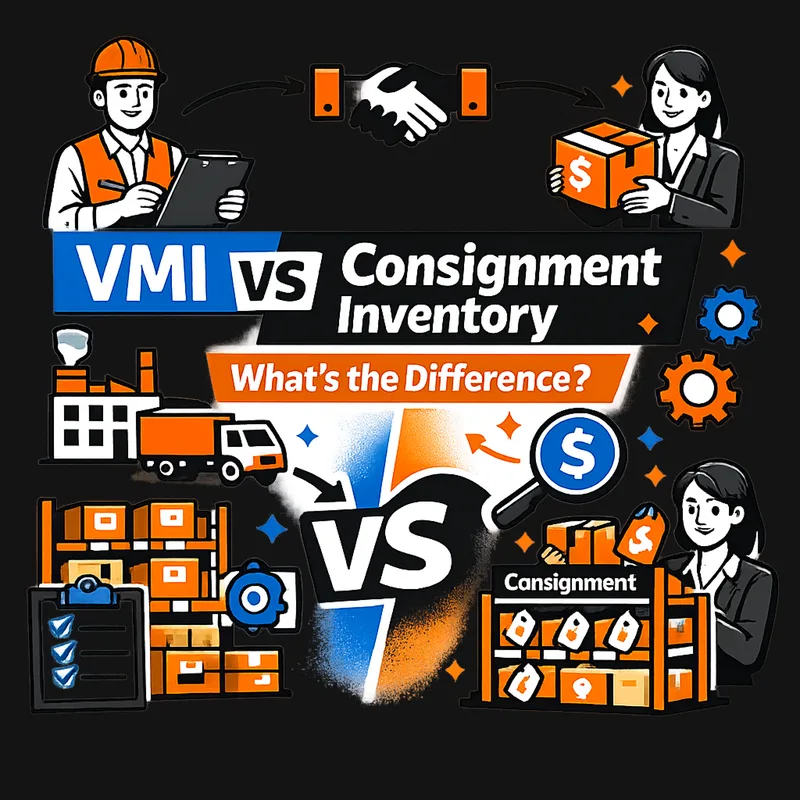
Here is the core distinction: vendor managed inventory vs consignment is not an either/or choice. VMI determines who manages your inventory replenishment. Consignment determines who owns the inventory sitting on your shelves. They operate on independent axes, which means you can use one without the other, or combine them into a hybrid model.

This article breaks down exactly how each approach works, where they overlap, and which one fits your manufacturing operation. If you are still building foundational knowledge about VMI, our complete vendor managed inventory guide covers the full model in detail.

Quick Comparison: Vendor Managed Inventory vs Consignment

Before diving into the details, this table captures the key differences at a glance.

FeatureVMIConsignment Inventory
Core question answeredWho manages replenishment?Who owns the inventory?
Inventory managementSupplier monitors and replenishesVaries (buyer or supplier)
Inventory ownershipBuyer (typically upon delivery or PO)Supplier (until consumed or sold)
Payment triggerAt delivery, receipt, or per PO termsAt consumption or sale
Risk of obsolescenceBuyer bears itSupplier bears it
Balance sheet treatmentInventory on buyer's booksInventory on supplier's books
Data sharing requiredHeavy (real-time inventory, demand data, forecasts)Moderate (consumption tracking, stock counts)
Implementation complexityHigh (EDI/API integration, shared systems)Moderate (tracking and reconciliation)
Supplier relationshipDeep, collaborative partnershipCan be transactional or collaborative
Best forHigh-volume, predictable demand itemsVariable demand, new products, working capital constraints

What Is Vendor Managed Inventory?

Vendor managed inventory is a supply chain arrangement where your supplier takes responsibility for monitoring your inventory levels, forecasting your demand, and making replenishment decisions on your behalf. Instead of your purchasing team placing orders when stock runs low, the supplier proactively ships materials based on real-time data from your operation.

The VMI process typically works like this: you share inventory data (through EDI, API integration, or a shared platform), the supplier analyzes consumption patterns and forecasts, and they ship replenishment stock according to agreed-upon min/max levels or forecast-driven schedules.

The critical thing to understand is that VMI says nothing about who owns the inventory. In most VMI arrangements, ownership transfers to the buyer at delivery, just like a traditional purchase order. The buyer pays for it on standard terms. What changes is who decides when and how much to order.

According to Netstock's 2024 Inventory Management Benchmark Report, only 29% of companies currently use VMI, largely because of the data-sharing infrastructure and supplier trust it demands.

What Is Consignment Inventory?

Consignment inventory is an arrangement where the supplier places stock at your location but retains ownership until you actually use or sell it. The inventory physically sits in your warehouse or on your production floor, but it does not appear on your balance sheet as an asset. It stays on the supplier's books until a consumption event triggers the ownership transfer.

Payment timing is the defining feature. Under consignment, you do not pay when goods arrive. You pay when you pull material into production, when a finished unit ships to a customer, or at whatever consumption event the contract specifies. Under ASC 606 (US GAAP), the supplier cannot recognize revenue until control of the goods transfers to the buyer, which in consignment does not happen at shipment.

For the buyer, this is a working capital advantage. You have materials on hand without tying up cash in inventory. For the supplier, it is a cash flow risk: they have manufactured and shipped products they have not been paid for yet.

The same Netstock benchmark found that only 19% of companies use consignment, a lower adoption rate than VMI. The financial risk suppliers assume makes many hesitant to offer consignment terms unless the buyer has significant purchasing volume or a strong relationship.

Key Differences Between Vendor Managed Inventory and Consignment

The comparison table above captures the headline differences. This section explains why each distinction matters for your operation.

Inventory Ownership and Payment Terms

This is the most consequential difference, and it flows directly into how each model affects your finances.

AspectVMIConsignment
When ownership transfersAt delivery or per PO termsAt consumption or sale
When you payNet 30/60/90 from deliveryNet 30/60/90 from consumption
Inventory on your balance sheetYesNo (until consumed)
Impact on your working capitalTies up capital at deliveryFrees working capital until usage
Supplier's cash flow exposureStandard receivables cycleExtended exposure until buyer consumes

In a standard VMI arrangement, you own the inventory once it arrives. You owe payment on standard terms from the delivery date, and the inventory appears as a current asset on your balance sheet. The only thing VMI changes is who makes the ordering decision.

In consignment, the supplier's capital is locked in your warehouse until you use the material. If your demand drops or a production run gets delayed, the supplier absorbs the holding cost. That makes consignment financially attractive for buyers, but it also means suppliers will be selective about which customers and which products they offer on consignment terms.

Risk Allocation

The risk profile of each model is nearly inverse, which is why they complement each other when combined.

Risk TypeVMI (Buyer's Risk)Consignment (Supplier's Risk)
ObsolescenceBuyer owns aging stockSupplier owns aging stock
Demand shortfallBuyer holds excess inventorySupplier holds excess exposure
Damage/loss at buyer siteBuyer responsible (their asset)Depends on contract, often shared
StockoutSupplier responsible (they manage replenishment)Depends on who manages replenishment
Price fluctuationBuyer locked at purchase pricePricing set at consumption (may float)

Under VMI, the supplier's risk is primarily reputational: if they manage your inventory poorly and you stockout, the relationship deteriorates. But the financial risk of excess or obsolete stock falls on the buyer.

Under consignment, the supplier carries financial risk directly. If they consign $200,000 of specialty fasteners to your warehouse and you only consume $50,000 in the first quarter, that is $150,000 of the supplier's capital sitting idle on your shelves. This is why consignment agreements typically include return provisions for unsold or unused stock and defined maximum holding periods.

Data Sharing and Technology Requirements

VMI is data-hungry by design. The supplier cannot manage what they cannot measure.

RequirementVMIConsignment
Real-time inventory levelsRequiredRecommended
Demand forecastsRequiredNot required
POS/consumption dataRequiredRequired (triggers payment)
EDI or API integrationStrongly recommendedHelpful but not essential
Shared planning platformCommonLess common
Periodic stock reconciliationStandardCritical (ownership depends on accuracy)

A successful VMI program requires your supplier to see your inventory data in near real-time through EDI, API connections, or cloud platforms. They need visibility into what you have on hand, what you are consuming, and ideally what your production schedule looks like. This is a significant technology investment and a trust commitment.

Consignment's data requirements are simpler in scope but stricter in accuracy. Since payment depends on consumption events, both parties need airtight tracking of what was consumed, when, and in what quantity. A miscount directly affects invoicing. Many manufacturers use barcode or QR-code scanning systems to create an auditable consumption trail.

Balance Sheet and Working Capital Impact

For CFOs and finance teams, this is often the deciding factor.

Under VMI with standard ownership terms, inventory hits your balance sheet at delivery. Your inventory carrying costs, typically 20-30% of inventory value annually according to ISM, apply from the moment goods arrive. Your working capital is tied up regardless of whether you use the material this week or next month.

Under consignment, that same inventory is the supplier's asset until you consume it. Your balance sheet stays lighter, your inventory turnover ratios look better, and your cash is available for other operational needs. For manufacturers managing tight working capital, this distinction can be transformative.

Supplier Relationship Dynamics

VMI fosters deep, collaborative partnerships. Your supplier invests in understanding your demand patterns, your production cycles, and your business. That creates value but also creates dependency. Switching VMI suppliers is complex because you are unwinding shared systems, data integrations, and institutional knowledge.

Consignment relationships can range from transactional to strategic. A supplier consigning commodity fasteners may treat it as a volume play with little collaboration. A supplier consigning engineered components may work closely with your engineering and production teams. The depth of relationship depends more on the product and volume than on the consignment model itself.

Can You Use VMI and Consignment Together?

Yes, and many organizations do. The VMI-consignment hybrid combines both models: the supplier manages replenishment and retains ownership until consumption. It is the best of both worlds when conditions allow it.

In a hybrid arrangement, the supplier monitors your inventory data, decides when and how much to replenish (VMI), and retains ownership of the stock sitting at your location until you use it (consignment). You get optimized replenishment without tying up working capital. Research published in the Journal of Industrial Distribution & Business found that VMI with consignment eventually generates higher supply chain profit than either model alone, though the early implementation period may not be immediately profitable.

Companies like Amazon and large retailers commonly use this hybrid model. In manufacturing, it works particularly well for MRO (maintenance, repair, and operations) supplies, where a distributor manages the supply closet and gets paid as items are consumed.

The hybrid model demands the most from both parties: the data infrastructure of VMI plus the inventory tracking rigor of consignment plus a high-trust supplier relationship that can sustain both.

Arda's visual Kanban system with QR-linked cards gives your shop floor real-time inventory visibility, the kind of consumption tracking that makes both VMI and consignment arrangements auditable without relying on complex ERP integrations. <a href="https://www.arda.cards">See how it works</a>.

Which Approach Is Right for Your Operation?

The right choice depends on three factors: your demand profile, your cash position, and your supplier relationships. This decision matrix covers the most common scenarios.

ScenarioRecommended ModelWhy
High-volume, predictable demandVMISupplier can forecast accurately; data sharing pays for itself
Variable or seasonal demandConsignmentSupplier absorbs demand risk; you avoid excess stock
Limited working capitalConsignment or hybridKeeps inventory off your books until consumed
Strong, long-term supplier relationshipVMI or hybridTrust supports data sharing and joint planning
Testing a new supplierConsignmentLower commitment; clear exit if the relationship sours
New or uncertain product linesConsignmentSupplier shares the risk of market acceptance
MRO and indirect materialsHybrid (VMI + consignment)Supplier manages the supply closet, gets paid per use
Critical production materialsVMIYou want proactive management to prevent stockouts
Many SKUs from one supplierVMIEconomies of scale in data integration and management
Commodity items with multiple sourcesConsignmentEasy to switch suppliers without unwinding integrations

If you are exploring how VMI compares to other inventory methodologies beyond consignment, our VMI vs Kanban analysis covers pull-based systems, and our vendor managed inventory examples article shows how manufacturers implement these models in practice.

Stop Stockouts Before They Start

No more stockouts, spreadsheets, or guesswork — generate smart Kanban cards that tell you what to order and when.
Make Free Reorder Cards

Never Run Out of Parts Again. Seriously.

Arda combines easy-to-use inventory software with scannable cards, so you can track, reorder, and organize without spreadsheets or setup headaches.

Frequently Asked Questions

Is vendor managed inventory the same as consignment inventory?

No. Vendor managed inventory determines who manages replenishment decisions. Consignment determines who owns the inventory until it is consumed. They answer different questions and can be used independently. You can have VMI without consignment (supplier manages, buyer owns at delivery), consignment without VMI (buyer manages, supplier owns until consumed), or both together in a hybrid model.

Can a supplier manage my inventory without a consignment agreement?

Yes, and this is the most common VMI arrangement. The supplier monitors your stock levels, forecasts demand, and makes replenishment decisions, but ownership transfers to you upon delivery, and you pay on standard purchase order terms. The supplier manages the process; you own the product.

Who pays for damaged or lost consignment inventory?

It depends on the contract, but the default assumption in most consignment agreements is that the consignee (buyer) is responsible for goods in their possession. Well-drafted consignment contracts specify insurance requirements, damage liability, and procedures for reporting loss. According to NetSuite, clear damage and loss provisions are essential elements of any consignment agreement.

What percentage of companies use VMI or consignment?

Adoption remains modest across industries. Netstock's 2024 benchmark report found that 29% of surveyed companies use VMI and 19% use consignment. These numbers suggest both models are still underutilized relative to their potential benefits, though the data infrastructure requirements explain the slower adoption curve.

Choosing Between VMI and Consignment: A Decision Framework

Vendor managed inventory vs consignment is not a binary choice. It is a question of which levers matter most for your specific operation. Use these three questions to guide your decision:

Question 1: What is your biggest pain point? If stockouts and reactive purchasing are costing you production time, VMI's proactive management solves that directly. If cash tied up in slow-moving inventory is constraining your operations, consignment frees that capital.

Question 2: What can your supplier infrastructure support? VMI requires real-time data sharing and systems integration. If your supplier has EDI capability and a dedicated inventory management team, VMI is feasible. If your suppliers are smaller and less technology-equipped, consignment's simpler tracking requirements may be more realistic.

Question 3: How much risk are you willing to share? Under VMI, you carry most of the financial risk but gain control over replenishment quality. Under consignment, your supplier absorbs financial risk but may push for higher per-unit pricing to offset it. The hybrid model distributes risk more evenly but demands the highest level of trust and infrastructure.

For many SMB manufacturers, the practical path starts with consignment on a few high-value, variable-demand SKUs and VMI on your high-volume, predictable items. As relationships and systems mature, the hybrid model becomes achievable for your most strategic supplier partnerships.

What is Kanban

Start for Free

Reorder cards + easy to use platform. Each card signals when it’s time to restock, so your team avoids stockouts, reduces waste, and keeps production flowing. With Kanban, your inventory reorders itself as items are used—simple, reliable, and perfectly in sync with demand.
Video Thumbnail
See Kanban in Action
Play Icon

VMI vs Consignment Inventory: Key Differences Explained

Vendor managed inventory and consignment inventory get used interchangeably in supply chain conversations. That is a mistake. These two strategies answer fundamentally different questions about your inventory, and confusing them leads to contracts with misaligned expectations and poorly structured supplier relationships.

Here is the core distinction: vendor managed inventory vs consignment is not an either/or choice. VMI determines who manages your inventory replenishment. Consignment determines who owns the inventory sitting on your shelves. They operate on independent axes, which means you can use one without the other, or combine them into a hybrid model.

This article breaks down exactly how each approach works, where they overlap, and which one fits your manufacturing operation. If you are still building foundational knowledge about VMI, our complete vendor managed inventory guide covers the full model in detail.

Quick Comparison: Vendor Managed Inventory vs Consignment

Before diving into the details, this table captures the key differences at a glance.

FeatureVMIConsignment Inventory
Core question answeredWho manages replenishment?Who owns the inventory?
Inventory managementSupplier monitors and replenishesVaries (buyer or supplier)
Inventory ownershipBuyer (typically upon delivery or PO)Supplier (until consumed or sold)
Payment triggerAt delivery, receipt, or per PO termsAt consumption or sale
Risk of obsolescenceBuyer bears itSupplier bears it
Balance sheet treatmentInventory on buyer's booksInventory on supplier's books
Data sharing requiredHeavy (real-time inventory, demand data, forecasts)Moderate (consumption tracking, stock counts)
Implementation complexityHigh (EDI/API integration, shared systems)Moderate (tracking and reconciliation)
Supplier relationshipDeep, collaborative partnershipCan be transactional or collaborative
Best forHigh-volume, predictable demand itemsVariable demand, new products, working capital constraints

What Is Vendor Managed Inventory?

Vendor managed inventory is a supply chain arrangement where your supplier takes responsibility for monitoring your inventory levels, forecasting your demand, and making replenishment decisions on your behalf. Instead of your purchasing team placing orders when stock runs low, the supplier proactively ships materials based on real-time data from your operation.

The VMI process typically works like this: you share inventory data (through EDI, API integration, or a shared platform), the supplier analyzes consumption patterns and forecasts, and they ship replenishment stock according to agreed-upon min/max levels or forecast-driven schedules.

The critical thing to understand is that VMI says nothing about who owns the inventory. In most VMI arrangements, ownership transfers to the buyer at delivery, just like a traditional purchase order. The buyer pays for it on standard terms. What changes is who decides when and how much to order.

According to Netstock's 2024 Inventory Management Benchmark Report, only 29% of companies currently use VMI, largely because of the data-sharing infrastructure and supplier trust it demands.

What Is Consignment Inventory?

Consignment inventory is an arrangement where the supplier places stock at your location but retains ownership until you actually use or sell it. The inventory physically sits in your warehouse or on your production floor, but it does not appear on your balance sheet as an asset. It stays on the supplier's books until a consumption event triggers the ownership transfer.

Payment timing is the defining feature. Under consignment, you do not pay when goods arrive. You pay when you pull material into production, when a finished unit ships to a customer, or at whatever consumption event the contract specifies. Under ASC 606 (US GAAP), the supplier cannot recognize revenue until control of the goods transfers to the buyer, which in consignment does not happen at shipment.

For the buyer, this is a working capital advantage. You have materials on hand without tying up cash in inventory. For the supplier, it is a cash flow risk: they have manufactured and shipped products they have not been paid for yet.

The same Netstock benchmark found that only 19% of companies use consignment, a lower adoption rate than VMI. The financial risk suppliers assume makes many hesitant to offer consignment terms unless the buyer has significant purchasing volume or a strong relationship.

Key Differences Between Vendor Managed Inventory and Consignment

The comparison table above captures the headline differences. This section explains why each distinction matters for your operation.

Inventory Ownership and Payment Terms

This is the most consequential difference, and it flows directly into how each model affects your finances.

AspectVMIConsignment
When ownership transfersAt delivery or per PO termsAt consumption or sale
When you payNet 30/60/90 from deliveryNet 30/60/90 from consumption
Inventory on your balance sheetYesNo (until consumed)
Impact on your working capitalTies up capital at deliveryFrees working capital until usage
Supplier's cash flow exposureStandard receivables cycleExtended exposure until buyer consumes

In a standard VMI arrangement, you own the inventory once it arrives. You owe payment on standard terms from the delivery date, and the inventory appears as a current asset on your balance sheet. The only thing VMI changes is who makes the ordering decision.

In consignment, the supplier's capital is locked in your warehouse until you use the material. If your demand drops or a production run gets delayed, the supplier absorbs the holding cost. That makes consignment financially attractive for buyers, but it also means suppliers will be selective about which customers and which products they offer on consignment terms.

Risk Allocation

The risk profile of each model is nearly inverse, which is why they complement each other when combined.

Risk TypeVMI (Buyer's Risk)Consignment (Supplier's Risk)
ObsolescenceBuyer owns aging stockSupplier owns aging stock
Demand shortfallBuyer holds excess inventorySupplier holds excess exposure
Damage/loss at buyer siteBuyer responsible (their asset)Depends on contract, often shared
StockoutSupplier responsible (they manage replenishment)Depends on who manages replenishment
Price fluctuationBuyer locked at purchase pricePricing set at consumption (may float)

Under VMI, the supplier's risk is primarily reputational: if they manage your inventory poorly and you stockout, the relationship deteriorates. But the financial risk of excess or obsolete stock falls on the buyer.

Under consignment, the supplier carries financial risk directly. If they consign $200,000 of specialty fasteners to your warehouse and you only consume $50,000 in the first quarter, that is $150,000 of the supplier's capital sitting idle on your shelves. This is why consignment agreements typically include return provisions for unsold or unused stock and defined maximum holding periods.

Data Sharing and Technology Requirements

VMI is data-hungry by design. The supplier cannot manage what they cannot measure.

RequirementVMIConsignment
Real-time inventory levelsRequiredRecommended
Demand forecastsRequiredNot required
POS/consumption dataRequiredRequired (triggers payment)
EDI or API integrationStrongly recommendedHelpful but not essential
Shared planning platformCommonLess common
Periodic stock reconciliationStandardCritical (ownership depends on accuracy)

A successful VMI program requires your supplier to see your inventory data in near real-time through EDI, API connections, or cloud platforms. They need visibility into what you have on hand, what you are consuming, and ideally what your production schedule looks like. This is a significant technology investment and a trust commitment.

Consignment's data requirements are simpler in scope but stricter in accuracy. Since payment depends on consumption events, both parties need airtight tracking of what was consumed, when, and in what quantity. A miscount directly affects invoicing. Many manufacturers use barcode or QR-code scanning systems to create an auditable consumption trail.

Balance Sheet and Working Capital Impact

For CFOs and finance teams, this is often the deciding factor.

Under VMI with standard ownership terms, inventory hits your balance sheet at delivery. Your inventory carrying costs, typically 20-30% of inventory value annually according to ISM, apply from the moment goods arrive. Your working capital is tied up regardless of whether you use the material this week or next month.

Under consignment, that same inventory is the supplier's asset until you consume it. Your balance sheet stays lighter, your inventory turnover ratios look better, and your cash is available for other operational needs. For manufacturers managing tight working capital, this distinction can be transformative.

Supplier Relationship Dynamics

VMI fosters deep, collaborative partnerships. Your supplier invests in understanding your demand patterns, your production cycles, and your business. That creates value but also creates dependency. Switching VMI suppliers is complex because you are unwinding shared systems, data integrations, and institutional knowledge.

Consignment relationships can range from transactional to strategic. A supplier consigning commodity fasteners may treat it as a volume play with little collaboration. A supplier consigning engineered components may work closely with your engineering and production teams. The depth of relationship depends more on the product and volume than on the consignment model itself.

Can You Use VMI and Consignment Together?

Yes, and many organizations do. The VMI-consignment hybrid combines both models: the supplier manages replenishment and retains ownership until consumption. It is the best of both worlds when conditions allow it.

In a hybrid arrangement, the supplier monitors your inventory data, decides when and how much to replenish (VMI), and retains ownership of the stock sitting at your location until you use it (consignment). You get optimized replenishment without tying up working capital. Research published in the Journal of Industrial Distribution & Business found that VMI with consignment eventually generates higher supply chain profit than either model alone, though the early implementation period may not be immediately profitable.

Companies like Amazon and large retailers commonly use this hybrid model. In manufacturing, it works particularly well for MRO (maintenance, repair, and operations) supplies, where a distributor manages the supply closet and gets paid as items are consumed.

The hybrid model demands the most from both parties: the data infrastructure of VMI plus the inventory tracking rigor of consignment plus a high-trust supplier relationship that can sustain both.

Arda's visual Kanban system with QR-linked cards gives your shop floor real-time inventory visibility, the kind of consumption tracking that makes both VMI and consignment arrangements auditable without relying on complex ERP integrations. <a href="https://www.arda.cards">See how it works</a>.

Which Approach Is Right for Your Operation?

The right choice depends on three factors: your demand profile, your cash position, and your supplier relationships. This decision matrix covers the most common scenarios.

ScenarioRecommended ModelWhy
High-volume, predictable demandVMISupplier can forecast accurately; data sharing pays for itself
Variable or seasonal demandConsignmentSupplier absorbs demand risk; you avoid excess stock
Limited working capitalConsignment or hybridKeeps inventory off your books until consumed
Strong, long-term supplier relationshipVMI or hybridTrust supports data sharing and joint planning
Testing a new supplierConsignmentLower commitment; clear exit if the relationship sours
New or uncertain product linesConsignmentSupplier shares the risk of market acceptance
MRO and indirect materialsHybrid (VMI + consignment)Supplier manages the supply closet, gets paid per use
Critical production materialsVMIYou want proactive management to prevent stockouts
Many SKUs from one supplierVMIEconomies of scale in data integration and management
Commodity items with multiple sourcesConsignmentEasy to switch suppliers without unwinding integrations

If you are exploring how VMI compares to other inventory methodologies beyond consignment, our VMI vs Kanban analysis covers pull-based systems, and our vendor managed inventory examples article shows how manufacturers implement these models in practice.

Related Blog Posts

Verify your users at scale
without the work