
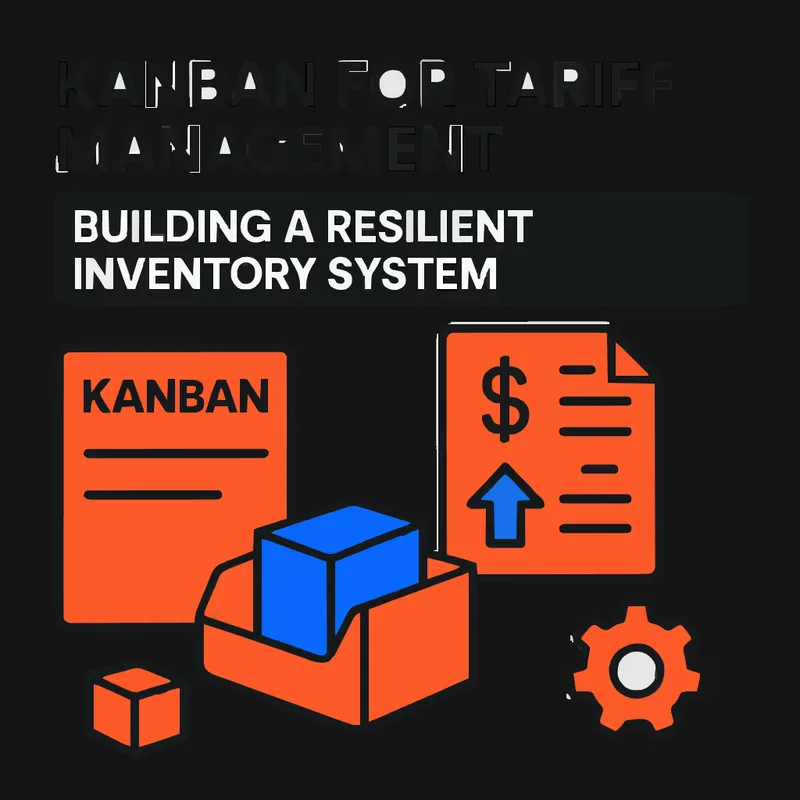
Kanban for Tariff Management: Build a Resilient Supply Chain in a Volatile World
Learn how kanban gives manufacturers a practical tariff management system that cuts costs, prevents stockouts, and builds supply chain resilience in volatile trade conditions.
In 2025, the Trump tariffs represented the largest tax hike for Americans since 1982, amounting to an average increase of more than $1,200 per US household. A striking 73% of Americans expected a price surge under these tariffs, sending shockwaves through manufacturing supply chains.
For manufacturers, the challenge goes beyond higher costs. Tariff volatility breaks the assumptions that traditional inventory systems depend on — stable lead times, predictable costs, and reliable suppliers. Material Requirements Planning (MRP) systems, designed for exactly those stable conditions, struggle to keep up when tariff changes arrive with little notice.
This is where a tariff management system built on kanban principles offers a fundamentally different approach. Rather than forecasting your way through uncertainty, kanban's pull-based system responds to actual demand in real time — making your supply chain naturally resilient to tariff disruptions. In this guide, we'll explore why kanban outperforms traditional methods for managing tariff-related challenges and how you can put it into practice.
What Is a Tariff Management System?
A tariff management system is any structured approach a business uses to track, analyze, and respond to tariffs — the taxes imposed on imported goods and raw materials. For manufacturers, effective tariff management means minimizing the cost impact of tariffs while maintaining production continuity.
Most enterprise tariff management systems focus on compliance and classification — assigning the correct Harmonized System (HS) codes, calculating duties, and monitoring trade policy changes. These tools are valuable for large importers, but they solve only half the problem for manufacturers on the shop floor.
The other half? Operational agility. When a 25% tariff hits your primary steel supplier overnight, knowing the correct HS code doesn't help you keep production running. You need a system that adjusts inventory levels, triggers alternative sourcing, and prevents stockouts — all without waiting for someone to manually recalculate your MRP parameters.
That's the gap kanban fills. Where traditional tariff management systems handle the compliance layer, kanban provides the operational layer — a real-time, demand-driven approach to inventory that naturally adapts when tariff conditions change.
Understanding the Tariff Landscape in 2025 and Beyond
The current tariff environment has reshaped how manufacturers think about supply chain strategy. With tariffs affecting everything from raw materials to finished goods across multiple countries, businesses face a complex web of trade regulations that shift with little warning.
A 2025 Deloitte study projected that 40% of U.S. companies would relocate at least part of their supply chains to North America by 2026, driven largely by tariff uncertainty. The Institute for Supply Management has called this a defining challenge for procurement professionals.
Tariffs disrupt manufacturing operations in three critical ways:
Increased Costs
Tariffs directly increase the cost of imported goods and raw materials. For manufacturers using components from affected countries, this can mean sudden price increases of 10-25% on critical inputs. A company producing electronics might see semiconductor costs jump overnight, forcing difficult decisions about pricing, sourcing alternatives, or absorbing margin impacts.
Lead Time Variability
Beyond direct costs, tariffs introduce significant lead time variability. As goods face additional customs scrutiny or companies scramble to find alternative suppliers, previously reliable delivery schedules become unpredictable. This variability wreaks havoc on production planning and can cascade through the entire supply chain, resulting in stockouts or excess inventory.
Supplier Uncertainty
Tariffs can suddenly make long-standing suppliers economically unviable, forcing businesses to quickly find and qualify new sources. This process typically takes months — time most manufacturers don't have when facing immediate tariff impacts.
The auto industry provides a sobering example. The 25% tariff on autos and parts created immediate price increases and supply chain chaos, with industry analysts projecting these tariffs would cut output by roughly 20,000 cars daily — approximately 30% of U.S. production.
These challenges highlight why traditional inventory strategies are no longer sufficient. Companies need systems that can absorb volatility rather than break under it.
Why Traditional MRP Fails in a Tariff-Sensitive Environment
Material Requirements Planning (MRP) has been the backbone of manufacturing inventory management for decades. But its core assumptions work against you when tariffs create rapid change:
Push-Based Forecasting
MRP operates as a push-based system where production is driven by forecasts, pushing materials through the supply chain regardless of actual demand. This approach works in stable environments but becomes a liability when tariffs create sudden demand shifts or supply constraints. When the forecast is wrong — and tariff volatility makes forecasts less reliable — you end up with the wrong inventory at the wrong time.
Fixed Lead Time Assumptions
Perhaps most problematically, MRP assumes relatively constant and predictable lead times. When tariffs disrupt established supply lines, add customs delays, or force supplier changes, these assumptions break down. The entire planning system then produces inaccurate requirements, creating a cascade of production problems.
Slow Response Cycles
MRP systems typically run on weekly or monthly planning cycles. When tariffs change, it can take weeks to reconfigure parameters, recalculate requirements, and generate new purchase orders. By that time, you've already committed to purchases at unfavorable prices or missed the window to secure alternative sources.
These limitations create real operational pain:
- Overstocking tariff-affected goods when forecasts fail to account for demand changes, tying up capital and increasing holding costs
- Inability to quickly switch suppliers when tariffs make existing sources uncompetitive, since MRP operates with a fixed supplier set
- Production delays from expedited shipping when the system can't adapt to new lead times fast enough
Consider this scenario: A furniture manufacturer using MRP receives a sudden notification that tariffs on imported wood will increase by 20% in 30 days. Their system has already generated purchase orders based on standard costs and lead times. By the time they reconfigure their MRP parameters, they've already committed to purchases that will arrive after the tariff increase — resulting in higher-than-expected costs and pricing challenges with customers who ordered based on pre-tariff quotes.
Kanban: A More Agile Tariff Management Approach for Manufacturers
While MRP struggles with tariff volatility, kanban offers a fundamentally different approach to inventory management that provides the agility manufacturers need when trade rules keep changing.
How Kanban Works as a Tariff Response System
Unlike MRP's forecast-and-push model, kanban uses actual consumption to trigger replenishment. Here's why that matters for tariff management:
- Pull-based replenishment: Materials move through the supply chain only when consumed, so inventory levels automatically adjust to real demand — not projections that tariffs have made unreliable.
- Demand-driven signals: Production is triggered only by genuine need. When tariff-induced price increases reduce customer demand, kanban naturally reduces ordering volume without manual intervention.
- Visual management: Kanban utilizes cards, boards, or digital displays showing real-time inventory status. Bottlenecks from tariff-related supply disruptions become immediately visible, enabling faster response.
Key Advantages for Tariff-Affected Manufacturers
Responsiveness to changing costs and lead times. When tariffs increase a component's price, kanban's pull system allows quick adjustments. You can modify reorder points, adjust card quantities, or switch supplier cards — all without recalculating an entire MRP schedule.
Reduced inventory exposure. By holding only what you need, kanban minimizes the financial risk of having large quantities of tariff-affected inventory on hand. If a tariff increases the replacement cost of your stock, your exposure is limited to what's in the kanban loop — not months of forecasted supply.
Improved supply chain visibility. Kanban provides a clear view of the entire production process, making it easy to identify which items are tariff-sensitive and where disruptions are forming. This transparency extends across your supply network, helping you spot problems before they cause costly downtime.
Faster supplier switching. When tariffs make a supplier uncompetitive, kanban systems adapt quickly. You update the card parameters for the new supplier and the system continues pulling based on consumption. No need to rebuild a master production schedule or rerun MRP calculations.
Kanban vs. MRP: Head-to-Head for Tariff Management
Understanding exactly where each system excels helps manufacturers make informed decisions about their tariff management approach:
| Factor | MRP (Push System) | Kanban (Pull System) |
|---|---|---|
| Response to tariff changes | Weeks to reconfigure planning parameters | Hours to adjust card quantities and reorder points |
| Demand alignment | Based on forecasts that tariffs make unreliable | Based on actual consumption — self-correcting |
| Lead time handling | Assumes fixed lead times — breaks when tariffs disrupt | Adapts continuously to real lead times |
| Inventory exposure | Months of forecasted supply at risk | Only active kanban loop quantities at risk |
| Supplier flexibility | Locked into fixed supplier set per BOM | Supplier cards updated independently |
| Visibility | Reports generated periodically | Real-time visual status of every item |
| Cost to implement | Expensive ERP modules + consultants | Incremental setup — start with one part, scale as needed |
| Shop floor usability | Requires ERP training and access | Visual cards anyone can understand |
The real-world impact of these differences compounds over time. A manufacturer managing 500 tariff-sensitive SKUs through MRP might spend weeks adjusting to a single tariff change. With kanban, those same adjustments happen naturally as consumption patterns shift, with targeted parameter changes for specific high-impact items.
How to Tariff-Proof Your Supply Chain With Kanban
Building tariff resilience is about choosing the right system and implementing the right strategies within that system. Here's how manufacturers can use kanban to create a supply chain that absorbs tariff shocks:
1. Identify Your Tariff-Sensitive Items
Start by mapping which materials, components, and supplies in your inventory are imported or contain imported content. These are your highest-risk items for tariff disruption. Prioritize implementing kanban for these items first — you can start with just one part and expand from there.
2. Set Strategic Safety Stock Levels
For tariff-sensitive items, calculate safety stock that accounts for potential lead time increases from customs delays or supplier switches. Kanban makes this straightforward — adjust the number of cards in the loop to increase buffer quantities for high-risk items while keeping non-tariff items lean.
3. Build Dual-Source Kanban Loops
For critical components, set up kanban loops with two or more qualified suppliers in different tariff zones. If a tariff makes one source uncompetitive, you shift volume to the alternative supplier by adjusting card allocation. This is far faster than re-sourcing through an MRP system.
4. Use WIP Limits to Control Tariff Cost Exposure
Kanban WIP limits cap the maximum amount of tariff-affected inventory in your system at any time. This is a powerful financial control — you know your maximum exposure to tariff-related cost increases and can plan accordingly.
5. Monitor Consumption Data for Early Warning
Kanban's real-time consumption data serves as an early warning system. If demand for products containing tariff-affected materials starts declining — often the first signal that price increases are hitting your market — you'll see it in the card velocity before it shows up in financial reports.
6. Use Free Trade Agreements
While kanban handles the operational side, don't overlook trade agreement optimization. The USMCA and other FTAs can reduce tariff-related costs by 10% or more for qualifying goods. Combine kanban's operational agility with strategic sourcing from FTA-compliant suppliers for maximum tariff protection.
Real-World Tariff Scenarios: Kanban vs. Traditional Approaches
Scenario 1: Sudden Tariff Increase on Steel
A metal fabrication shop sources steel from a Chinese supplier. A new 25% tariff is announced with 30 days' notice.
MRP response: The system has already generated purchase orders based on pre-tariff costs. Reconfiguring supplier data, updating costs, and regenerating requirements takes 2-3 weeks. During transition, the shop either pays the higher tariff on committed orders or faces stockouts while switching suppliers.
Kanban response: The shop has dual-source cards — one for the Chinese supplier and one for a domestic alternative. Within days, they shift card allocation to favor the domestic source. Consumption continues uninterrupted while the transition happens naturally through the pull system.
Scenario 2: Tariff-Induced Demand Drop
A manufacturer of consumer electronics sees demand fall 15% as tariff-related price increases reduce consumer purchasing.
MRP response: The system continues pushing production based on the original forecast until someone manually adjusts demand projections. Excess inventory accumulates, tying up capital in goods that now cost more to produce.
Kanban response: Fewer cards circulate because actual consumption has dropped. The system automatically slows purchasing and production, keeping inventory aligned with real demand. No manual intervention needed.
Building Long-Term Supply Chain Resilience
Tariff volatility isn't going away. Industry analysts describe the current environment as the "new normal" — tariffs are now a permanent variable that manufacturers must manage, not a temporary disruption to wait out.
Building genuine resilience requires:
- Operational agility — the ability to adjust inventory and sourcing quickly when conditions change
- Financial visibility — knowing your tariff exposure at all times, not just at the end of a planning cycle
- Continuous improvement — using consumption data to optimize your response over time
- Cross-functional alignment — connecting procurement, production, and finance through shared visual signals
Kanban delivers all four. Its pull-based nature provides operational agility. Its visual management creates financial visibility. Its data capture enables continuous improvement. And its simplicity ensures everyone from the shop floor to the executive suite can understand and act on the same information.
This is why lean manufacturing and kanban are increasingly recognized as essential tools for tariff management — not just for efficiency, but for survival in a volatile trade environment.
Frequently Asked Questions
What is a tariff management system for manufacturers?
A tariff management system is a structured approach for tracking tariff changes, calculating cost impacts, and adjusting inventory and sourcing strategies to maintain production continuity. For manufacturers, the most effective systems combine compliance tools (for tariff classification and duty calculation) with operational systems like kanban that adjust inventory levels in real time based on actual demand.
How does kanban help with tariff-related supply chain disruptions?
Kanban's pull-based system responds to actual consumption rather than forecasts, so inventory levels self-correct when tariffs change demand patterns. Manufacturers can adjust reorder points, switch suppliers, and modify safety stock levels within hours rather than the weeks required by MRP systems. This makes kanban particularly effective during periods of volatile demand and tariff uncertainty.
Can kanban and MRP work together for tariff management?
Yes. Many manufacturers use MRP for long-lead-time, high-cost components where forecasting is still valuable, while using kanban for variable consumption goods and tariff-sensitive items where agility matters most. Kanban can splice in alongside existing ERP systems to provide the operational flexibility that MRP alone lacks.
How do I start implementing kanban for tariff-sensitive items?
Begin with your highest-risk, tariff-affected items. Map which materials are imported or contain imported content, then set up kanban loops for those items first. The advantage of kanban is that you can start with a single part and scale incrementally — no need for a full system overhaul. Most manufacturers see measurable improvements within the first few weeks.
How do WIP limits help manage tariff costs?
WIP limits cap the maximum inventory of tariff-affected materials in your system at any time. This creates a predictable ceiling on your tariff cost exposure. If a tariff increases material costs by 20%, your financial risk is limited to the maximum WIP amount — not months of forecasted supply sitting in a warehouse.
Take Control of Tariff Uncertainty
Tariff volatility is challenging, but it doesn't have to mean production chaos. Manufacturers who adopt pull-based systems gain a structural advantage — their supply chains adapt to changing conditions by design, not by scrambling to update spreadsheets and recalculate MRP parameters.
Kanban gives you the operational agility to respond to tariff changes in hours, the visibility to understand your exposure in real time, and the simplicity to get your entire team aligned without expensive software implementations.
If you're ready to build a supply chain that absorbs tariff shocks instead of breaking under them, schedule a call to see how Arda's kanban system can help your manufacturing operation thrive in a volatile trade environment.
Make the first replenishment loop visible.
Generate free Kanban cards for the parts that most often stop production.
Make Free Kanban CardsRelated reading
Why Your Team Is Cannibalizing Finished Goods to Ship Orders
Learn why manufacturing teams disassemble finished products to fill orders, the hidden costs of inventory cannibalization, and how a pull-based system stops it for good.
Mar 20, 2026Read article
Inventory Control Techniques: A Manufacturer's Guide to ABC, JIT, EOQ, Kanban & More
Master proven inventory control techniques for manufacturing — ABC analysis, JIT, EOQ, Kanban, MRP & more. Cut costs 10-30% and eliminate stockouts.
Mar 20, 2026Read article
Why Overproduction Is The Mother of All Lean Wastes
Discover how overproduction quietly triggers every other LEAN waste, from excess inventory to hidden defects. Learn to stop the #1 drain on your profit.
Mar 20, 2026Read article