
Managing Tariff Costs: How Kanban WIP Limits Mitigate Risks
Learn how kanban WIP limits help manufacturers manage tariff costs, reduce inventory risk, and build resilient supply chains. Practical strategies and examples inside.
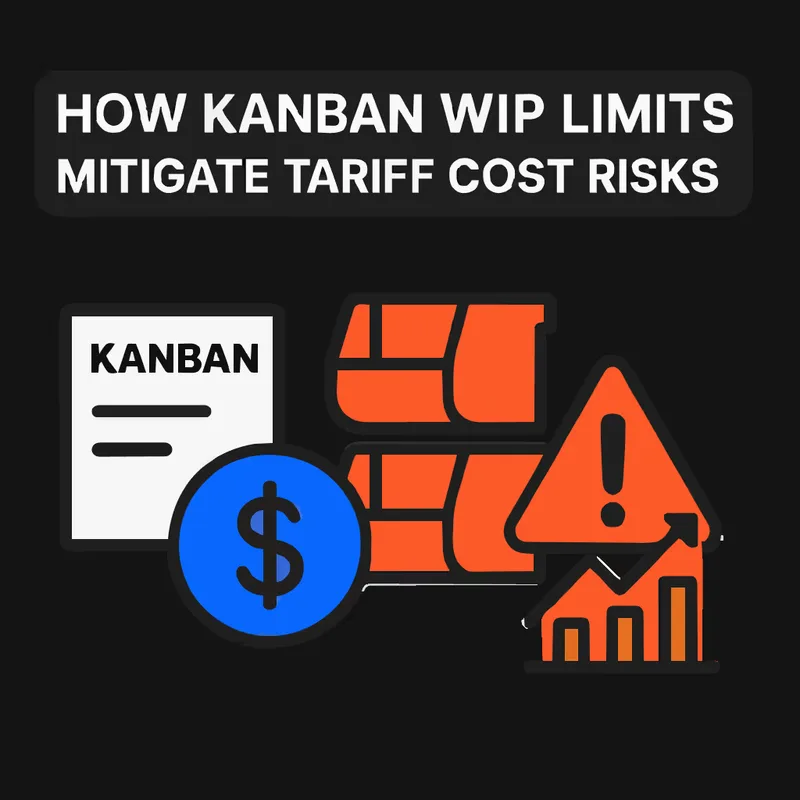
Are rising tariffs squeezing your profit margins? A recent report shows that tariffs are projected to increase consumer losses to $3,800 per household, significantly impacting consumer demand and creating ripple effects throughout supply chains. For manufacturers navigating this challenging landscape, having a deliberate tariff cost management response has become a critical priority.
Tariffs are taxes imposed on imported goods, increasing the cost of imported materials and finished products. This can lead to supply chain disruptions, increased prices for consumers, and reduced competitiveness for businesses. As tariff volatility continues to shape global trade, companies need more agile approaches to inventory management and production planning.
Enter Kanban — a visual production management system that emphasizes limiting work in progress (WIP). This methodology offers a more responsive approach to managing inventory and production in the face of tariff volatility. By implementing kanban WIP limits, businesses can minimize financial exposure to tariff fluctuations while maintaining operational efficiency.
In this article, we'll explore how WIP limits can help your manufacturing business mitigate tariff cost risks, the practical benefits of WIP limits for inventory control, and how to build a more resilient supply chain capable of adapting to today's uncertain trade environment.
Understanding the Tariff Landscape in 2025
The global trade landscape in 2025 is characterized by increasing tariff volatility and trade policy uncertainty. According to the World Trade Organization, reciprocal tariffs and spreading trade policy uncertainty could lead to a 1.5% decline in world merchandise trade in 2025. This volatility creates significant challenges for businesses trying to maintain predictable supply chains and manage costs effectively.
How Tariffs Disrupt Traditional Inventory Management
Tariffs disrupt traditional inventory management in several key ways:
- Increased costs of imported goods and raw materials: The price level from all 2025 tariffs is projected to rise by 2.3% in the short-run, directly impacting product costs and profit margins.
- Lead time variability and supplier uncertainty: Tariffs can lead to unpredictable changes in lead times as suppliers adjust to new regulations and trade barriers, making planning more difficult.
- Panic buying and overstocking: When tariff announcements create uncertainty, many manufacturers rush to stockpile materials — tying up capital in inventory that may lose value if tariffs shift again. Understanding how volatile demand and tariffs inflate your inventory costs is key to avoiding this trap.
Real-World Impact of Tariff Disruption
The effects of tariff challenges are already being felt across various sectors. Approximately 9% of business owners reported losing international business due to foreign customers being impacted by tariffs or disruptions in supplier relationships.
Different industries are experiencing unique challenges in managing tariff costs:
Manufacturing: The most affected industries are in manufacturing, particularly those with strong exposure to imports from China and North America. With 77% of companies passing costs to customers through price increases, finding ways to absorb or reduce tariff impact is a competitive advantage.
Construction: According to Moody's Analytics, the effective tariff rate is now expected to peak in the second quarter of 2025, creating significant cost pressures for construction projects.
Small and medium businesses (SMBs) are particularly vulnerable to tariff risks, with 87% of small and medium manufacturers potentially needing to raise prices due to tariffs, and one-third possibly slowing hiring.
The Limitations of Traditional Inventory Management (MRP)
When it comes to managing tariff costs through resilient supply chain practices, traditional inventory management systems like Material Requirements Planning (MRP) often fall short. Understanding these limitations is crucial for businesses seeking more adaptive approaches.
Core Principles of MRP and Its Struggles with Tariff Volatility
MRP is fundamentally a push-based system driven by forecasts. These systems generate production schedules based on anticipated demand, pushing materials and components through the supply chain according to predetermined timelines. This approach relies heavily on accurate forecasts and fixed lead times — which become increasingly unreliable in a tariff-sensitive environment.
The core problem? Push-based systems commit capital before demand is confirmed. In a volatile tariff environment, that commitment becomes a liability. Understanding the difference between push vs. pull inventory management is essential for choosing the right approach.
Challenges of Using MRP in a Tariff-Sensitive Environment
- Inability to quickly adjust to changing lead times: Tariffs can cause sudden changes in lead times, making it difficult for MRP systems to adjust production schedules accordingly. When suppliers face new tariffs, their delivery timelines often shift, but MRP systems typically lack the flexibility to rapidly accommodate these changes.
- Risk of overstocking due to inaccurate forecasts: Inaccurate forecasts can lead to overstocking of materials subject to tariffs, increasing costs and reducing profitability. In an attempt to buffer against tariff-related uncertainties, businesses using MRP might overcompensate by ordering larger quantities, further exposing themselves to tariff costs.
- Limited flexibility in sourcing decisions: MRP systems often rely on fixed supplier relationships, making it difficult to quickly switch to alternative sources in response to tariffs. This rigidity can prevent businesses from pivoting to suppliers in regions not affected by new tariff policies.
As tariff challenges continue to evolve, these limitations of traditional inventory management approaches become more pronounced, highlighting the need for more adaptive methodologies.
Kanban: A More Agile Approach to Tariff Adaptation
While traditional inventory management systems struggle with tariff volatility, Kanban offers a refreshingly different approach that's inherently more adaptable to changing trade conditions.
Kanban as a Pull-Based System
Kanban is fundamentally a pull-based system that emphasizes flexibility and responsiveness, allowing businesses to adapt quickly to changing market conditions and tariff policies. Unlike push-based systems, Kanban initiates production only when there is actual customer demand, reducing the risk of overstocking items that may be subject to fluctuating tariff costs.
Core Principles of Kanban
Pull-based system driven by actual customer demand: Kanban systems initiate production only when there is actual customer demand, reducing the risk of overstocking and minimizing exposure to tariff-affected inventory.
Demand-driven production with visual signaling: Kanban uses visual signals, such as kanban cards and boards, to communicate demand and manage workflow. This visibility makes it easier to identify and respond to tariff-related disruptions before they cascade throughout the supply chain.
Advantages of Kanban in a Tariff-Sensitive Environment
- Responsiveness to changing demand and lead times: Kanban systems can quickly adjust to changing demand and lead times by adjusting production based on actual customer orders rather than potentially inaccurate forecasts.
- Reduced inventory levels and holding costs: By producing only what is needed when it's needed, Kanban systems minimize inventory levels, reducing holding costs and the financial risk associated with tariff-affected goods.
- Improved visibility into the supply chain: Kanban boards provide a visual representation of the supply chain, allowing businesses to identify bottlenecks and potential disruptions caused by tariff changes.
- Increased flexibility in sourcing: Kanban systems can be adapted to accommodate multiple suppliers, allowing businesses to switch to alternative sources in response to tariffs with minimal disruption to production flow.
This agility makes Kanban well-suited for businesses managing tariff costs while trade rules keep moving.
Related reading
How Lean Manufacturing Enables Tariff Management and Resilient Manufacturing
Learn how lean manufacturing and Kanban systems help manufacturers manage tariff costs, reduce waste, and build resilient supply chains. Step-by-step roadmap inside.
Mar 20, 2026Read article
What Is a Kamishibai Board? A Guide for Manufacturing Leaders
Boost shop floor accountability. Learn what a kamishibai board is, its benefits, and how to build this lean manufacturing tool for process audits.
Nov 13, 2025Read article
5 Ways Volatile Demand and Tariffs Inflate Your Inventory Costs (And How to Fight Back)
Tariffs and volatile demand drive up carrying costs, storage fees, and obsolescence risk. Learn 5 proven strategies to reduce inventory costs and protect margins.
Mar 20, 2026Read articleMake the first replenishment loop visible.
Generate free Kanban cards for the parts that most often stop production.
Make Free Kanban Cards