Your item database, built from orders you have already placed
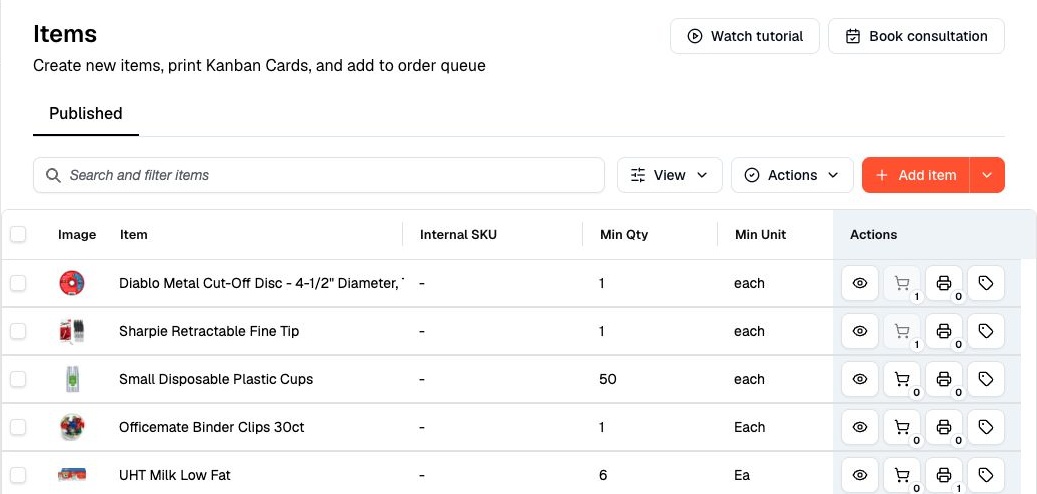
Everything you stock in one searchable place, with the photo, the supplier, and the reorder point attached to each item.
Reordering means guessing which one you bought last time.
The item record has no photo, no SKU, and no link to the supplier.
How it works
- 1
Import
Bring in a CSV, or add an item from an Amazon product URL.
- 2
Set minimums
Set the reorder point once, and the card carries it.
- 3
Print and place
Print the cards and get them onto the floor.
Feature breakdown
Start from what you already buy
Bring in vendor order history rather than building a catalog from scratch. Only a title is required to create an item, so records can start rough and improve.
- Start with the routine items, not everything.
- Rough records beat no records.
The record holds what reordering needs
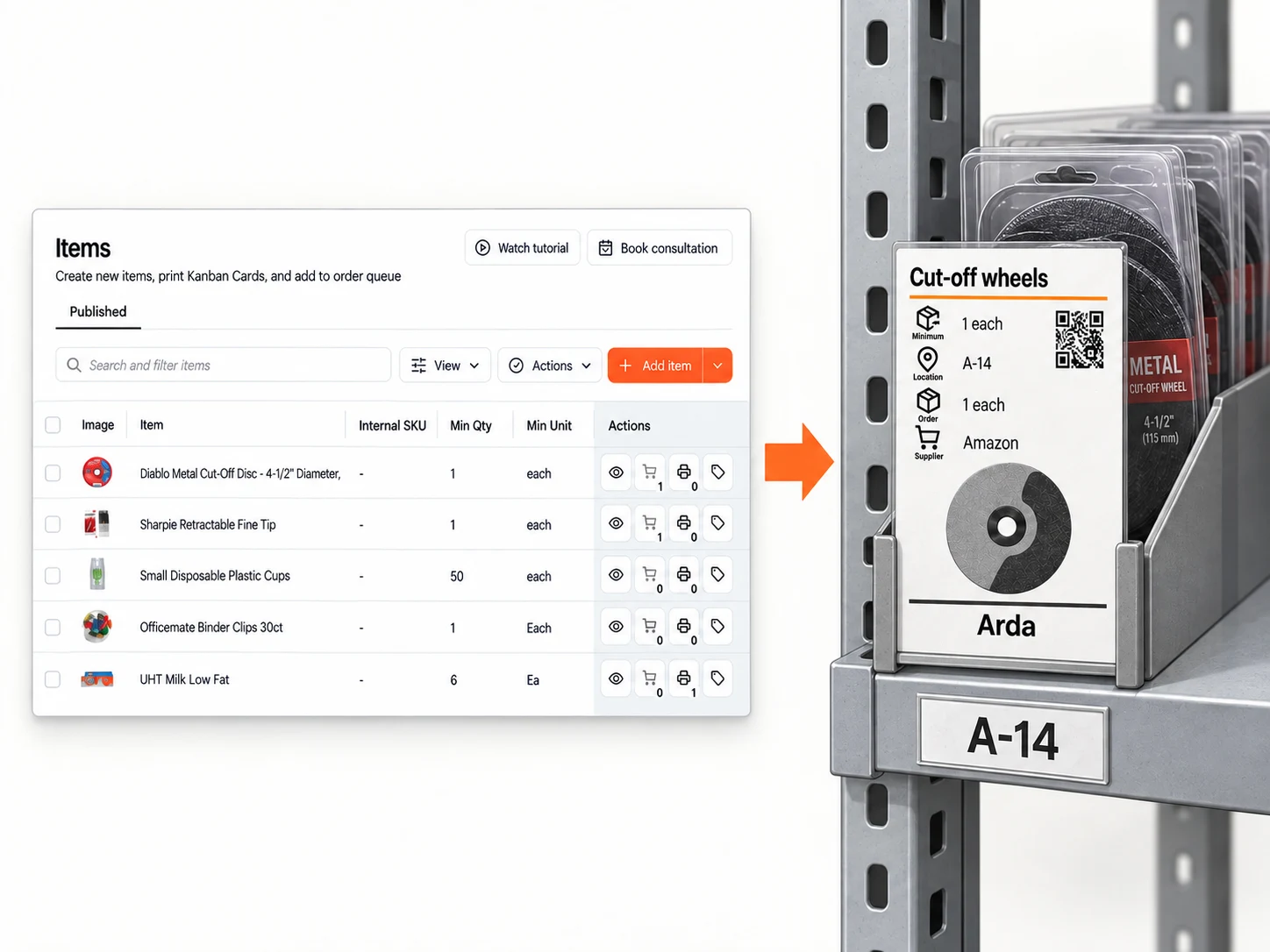
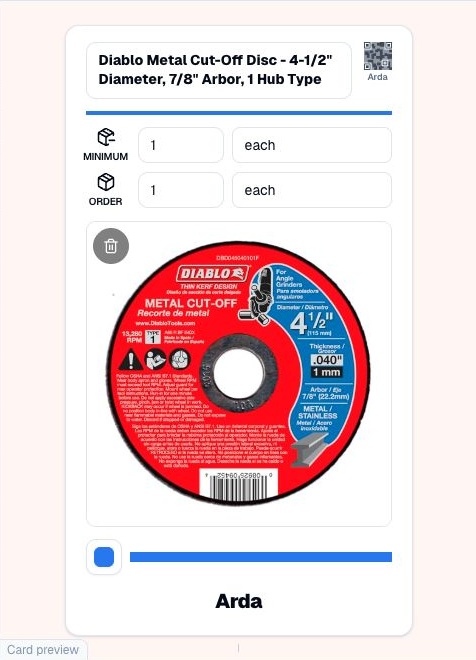
A photo, a SKU, a supplier, an ordering link, a unit and a price live on the item, and the photo carries through to the card and the shelf label.
- Photos on every item, card and label.
- A fallback supplier when the first one is out.
Reorder points you can defend
Minimum quantity is the on-hand level that triggers a scan; order quantity is what gets added when it does. You set both once and print them on the card.
- Set it once, the card carries it.
- Tune it on the floor walk, not in a meeting.
- Min qty
- 2
- Order qty
- 6
Start with the routine items
Most of what a shop consumes is predictable. Begin there, where automatic replenishment works, and move less predictable items in as their patterns become clear.
- Begin with the consumables the ERP never held.
- Move more onto automatic replenishment over time.
Why it matters
- For the person reordering
- The question “is this the right one” stops being a judgment call. The photo and the SKU answer it.
- For the Purchasing Manager
- The catalog stops being one person's knowledge. A new hire can find what a long-tenured person knew.
- For operations
- Reorder points become tunable rather than mythical, and short-and-over stops being a monthly condition.
- Strategically
- Everything else rests on this layer: no card prints without an item, and no order goes out without a supplier on the record. It is also the cheapest place to reduce the single-person dependency.
- Risk of leaving it alone
- The distrust compounds. Reorder points nobody believes get overridden, which produces the over-ordering that ties up cash while shortages continue.