
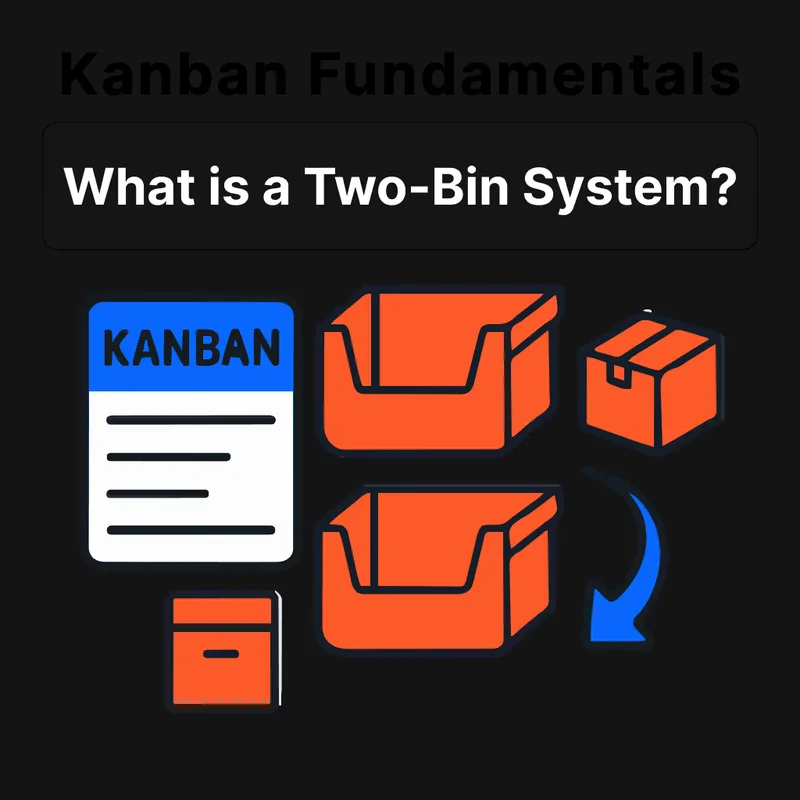
What Is a Two-Bin System and How Does It Work?
Learn what a two-bin system is and how it works step by step. Includes bin size formulas, implementation tips, and real-world examples for manufacturers.
A two-bin system holds each part in two containers. The floor draws from one; when it empties, that empty bin is the reorder signal, and the second bin keeps production running until the refill lands. It is also called a twin-bin or double-bin system.
That is the whole mechanism. It tells you exactly when to replenish without a count, a report, or a forecast, and it keeps stock from piling up between refills.
The two-bin system has gained popularity across manufacturing, healthcare, and other industries due to its simplicity and effectiveness — particularly for small, frequently used items. In this guide, you'll learn how the two-bin system works step by step, how to calculate the right bin size, when to use it, and how it compares to other inventory control techniques.
What Is a Two-Bin Kanban System?
A two-bin kanban system is a visual, pull-based inventory method that uses two physical containers (bins) for each item. The system operates on a simple principle: when one bin is empty, it signals the need to reorder while the second bin contains enough stock to cover operations until the replenishment arrives.
Here's how the two bins are set up:
- Bin A (Working Stock): Contains items currently being used in production.
- Bin B (Reserve Stock): Contains backup inventory to be used when Bin A is depleted.
When Bin A becomes empty, it triggers a replenishment order, and workers begin using items from Bin B. By the time Bin B is running low, the replenishment order for Bin A should have arrived, allowing the cycle to continue. This creates a continuous flow of materials without excessive inventory or stockouts.
The two-bin kanban system runs on what workers can see. There's no need for complex software or constant inventory counts. The empty bin itself serves as the signal — or "kanban" — that triggers the reordering process. In fact, kanban cards originated from this exact concept of visual signals driving replenishment.
How Does the Two-Bin System Work?
Implementing a two-bin system involves a straightforward, repeatable process:
- Set up Bin A in the primary location where workers can easily access it.
- Place Bin B behind or below Bin A as the reserve stock.
- Add a reorder card at the bottom of both bins with relevant information (part number, quantity, supplier, etc.).
- Use materials from Bin A until it's empty.
- When Bin A empties, move Bin B to the primary position and begin using those materials.
- Trigger a replenishment order using the reorder card from Bin A.
- When new stock arrives, refill Bin A and place it in the reserve position.
- The cycle repeats when Bin B becomes empty.
The system ensures there's always enough inventory on hand to maintain production while minimizing excess stock. The key is determining the right quantity for each bin, which should be based on usage rates and lead times for replenishment.
Quick example: If a company uses 800 fasteners per week (160 per day) with a supplier lead time of three days, the reserve bin should stock at least 480 fasteners. Adding safety stock to account for potential fluctuations in demand or delivery delays is also recommended.
Bin B needs a card on it for the loop to work. You can make your first kanban cards free and have them on the bins before your next refill.
Key Benefits of the Two-Bin System
The two-bin system delivers several measurable benefits for organizations that implement it correctly. For a deeper look at each benefit with industry examples, see our full guide on the advantages of the two-bin kanban system.
Reduced Risk of Stockouts
The second bin acts as a built-in safety net, ensuring you have enough inventory to cover the replenishment lead time. This simple approach provides continuous material availability and reduces production disruptions.
Simplified Inventory Management
Unlike inventory tracking software, the two-bin system uses visual signals that anyone on the shop floor can understand. There's no counting required — each empty bin automatically signals that it needs refilling. This is a major improvement over PAR-level systems that require manual counts of every item.
Improved Efficiency
Assessment times in inventory management can be drastically reduced. One healthcare facility reported that assessment times dropped from 18–20 minutes per OR suite to just 20–40 seconds after implementing a two-bin kanban system — an improvement of over 3,800%.
Reduced Costs
Organizations implementing kanban can experience a 50% reduction in coordination costs in under six months. For a department with a $20M operating budget, coordination costs can decrease from 20% to 10%, saving $2M within 18 months. Implementing kanban can also lead to throughput doubling and lead time reductions of 10% to 50%.
Calculating the Right Bin Size and Reorder Point
Determining the correct bin size and reorder point is crucial for the success of a two-bin system. Getting this wrong is the most common reason two-bin implementations fail.
The Reserve Stock Formula
The formula for calculating reserve stock (Bin B quantity) is:
(Daily usage rate × lead time in days) + safety stock
For example, if your shop uses 160 fasteners per day with a three-day supplier lead time and you want a 20% safety buffer:
- Base reserve: 160 × 3 = 480 fasteners
- Safety stock (20%): 480 × 0.20 = 96 fasteners
- Total Bin B quantity: 576 fasteners
The Kanban Bin Size Formula
For determining the total number of items across both bins, a common kanban formula is:
Number of kanbans = (D × L × (1 + S)) / C
Where:
- D = Daily demand
- L = Lead time (in days)
- S = Safety stock factor (as a decimal, e.g., 0.20 for 20%)
- C = Container (bin) capacity
Tips for Accurate Bin Sizing
- Track actual usage over at least 2–4 weeks before setting bin quantities.
- Factor in variability — if demand swings by ±30%, your safety stock should reflect that.
- Review and adjust bin sizes quarterly based on consumption data. This is where a digital tracking layer — like a system that captures real consumption data from every reorder — becomes invaluable.
Two-Bin System vs. Other Inventory Management Methods
Understanding how the two-bin system compares to other approaches helps you choose the right method for each item in your inventory.
One-Bin System
The one-bin system provides supply at preset intervals, not based on stock levels or kanban signals. While simpler, it doesn't respond to actual usage and can lead to either overstocking or stockouts.
Three-Bin Kanban System
The three-bin system is similar to the two-bin system, but the supplier keeps one bin reserved at their location. This provides additional security against stockouts but requires more coordination with suppliers.
Perpetual Inventory System
Used for higher-value items, the perpetual inventory system maintains a continuous record of inventory levels. While more precise, it requires more sophisticated tracking systems and regular counting.
| Method | Best For | Signal Type | Complexity |
|---|---|---|---|
| Two-Bin | Low-value, high-frequency items | Visual (empty bin) | Low |
| One-Bin | Stable, predictable demand | Time-based schedule | Very Low |
| Three-Bin | Items with long lead times | Visual (empty bin) | Medium |
| Perpetual | High-value items | Digital count | High |
For a broader comparison of push vs. pull inventory management approaches, see our dedicated guide.
Is a Two-Bin System the Same as One-Card Kanban?
This is one of the most common questions in kanban implementation. The short answer: yes, a two-bin system is mathematically equivalent to a one-card kanban system.
In a one-card kanban system, a single card travels with the material and gets returned when the container empties — triggering a replenishment order. In a two-bin system, the empty bin itself serves as the "card." The signal mechanism is different, but the underlying logic is identical.
Here's how they compare:
| Feature | Two-Bin System | One-Card Kanban |
|---|---|---|
| Signal | Empty bin | Detached card |
| Trigger | Bin emptied completely | Card returned to supplier/staging |
| Best for | Low-value, bulky items | Parts of various sizes |
| Tracking | Visual only (unless digitized) | Card provides paper trail |
| Math | Same formula for quantity | Same formula for quantity |
The practical difference? Two-bin systems are easier to set up because the bin is the signal — no cards to lose or track. However, a traditional one-card kanban loop offers more flexibility since cards can carry detailed information like part numbers, supplier details, and quantities.
When to choose which:
- Two-bin works best for small, standardized parts with consistent demand (fasteners, adhesives, packaging).
- One-card kanban works better when you need detailed tracking or when items vary in size and don't fit neatly into standardized bins.
Limitations of the Two-Bin System
While the two-bin system is powerful, it's important to understand where it falls short:
Not Suitable for All Items
The system works best for small, low-value items with predictable demand. High-value items or those with highly variable demand may require different inventory management approaches — see our guide on managing variable consumption goods.
Requires Accurate Demand Forecasting
The effectiveness of the system depends on accurate forecasting of demand and lead times. Inaccurate forecasts can lead to either overstocking or understocking. If your demand swings wildly, you'll need larger safety buffers or a more adaptive system.
Reliance on Timely Replenishment
The system relies on consistent and reliable suppliers. If replenishment orders are delayed, the second bin may be depleted before new stock arrives, leading to stockouts. This is why the reserve bin formula includes safety stock.
Implementing a Two-Bin System: 10 Practical Tips
- Choose accessible locations that all involved departments can reach, with enough space for both bins.
- Match bins to materials — select containers that fit the size of the items and are light, sturdy, and easy to clean.
- Calculate maximum capacity based on daily requirements and supplier lead time (use the formulas above).
- Label bins clearly with material name, product code, and reorder quantity for instant visual identification.
- Choose the right signaling system — color-coded bins, reorder cards, or digital signals — so it's immediately clear which items are in stock vs. on order.
- Train your team so everyone understands how the cycle works, how to trigger reorders, and who's responsible.
- Document order procedures that describe how and when to place new orders, including supplier contacts and expected lead times.
- Conduct regular audits to assess stock levels and ensure bins are stocked correctly — at least monthly.
- Optimize storage layout by placing frequently used items close to workstations to minimize search and walking time.
- Consider adding a digital layer to save time, avoid errors, and capture consumption data that helps you optimize bin sizes over time. You can create kanban cards that bridge physical simplicity with digital intelligence.
How Arda Supercharges the Traditional Two-Bin System
Traditional two-bin systems have been manufacturing staples for decades, but they've always had limitations. Manual cards get lost, bins get misplaced, and there's no data capture to optimize your inventory levels over time.
Arda's hybrid kanban system preserves what works about traditional two-bin methods while solving their inherent problems. Our system combines the simplicity of physical kanban cards with the power of real-time digital tracking — creating a tool that's both shop-floor friendly and executive-approved.
The result? Customers typically see a 90% reduction in time spent managing inventory while maintaining perfect stock levels. The data captured from every reorder cycle feeds back into smarter bin sizing and reorder point calculations, so your system gets better over time.
Ready to see how it works? Watch a demo or check out pricing to get started.
Frequently Asked Questions
What items work best in a two-bin system?
Two-bin systems work best for low-value, high-frequency items with relatively predictable demand — things like fasteners, adhesives, welding consumables, packaging materials, cleaning supplies, and cutting tools. These are items where the cost of a stockout far exceeds the cost of holding a small buffer.
How do I know if my bin sizes are correct?
If you're running out of Bin B before replenishment arrives, your bins are too small. If both bins are always full, they're too large (tying up capital). Track how many days of stock remain in Bin B when replenishment arrives — aim for 1–2 days of buffer remaining.
Can a two-bin system work alongside an ERP?
Absolutely. Many manufacturers use two-bin systems for consumables and variable consumption goods while their ERP handles higher-value components on the bill of materials. The two approaches complement each other — the two-bin system fills the gap where ERPs typically fall short.
What's the difference between a two-bin system and a PAR-level system?
A PAR-level system requires counting every item to check if inventory has dropped below a set level. A two-bin system requires no counting — the empty bin is the signal. This makes two-bin systems faster and less error-prone, especially in high-volume environments.
Conclusion
The two-bin system offers a simple yet powerful approach to inventory management that can significantly improve efficiency, reduce costs, and prevent stockouts. If you are managing consumables on a manufacturing floor or supplies in a healthcare facility, the core principle remains the same: two bins, one signal, zero guesswork.
The key to success is getting your bin sizes right (use the formulas above), training your team on the process, and reviewing bin quantities regularly as demand changes. For manufacturers looking to take the next step, adding a digital tracking layer turns a good system into a great one — capturing data that continuously improves your reorder accuracy.
Ready to eliminate stockouts and simplify your inventory management? Schedule a call to see how Arda's hybrid kanban system can work for your operation.
Make the first replenishment loop visible.
Generate free Kanban cards for the parts that most often stop production.
Make Free Kanban CardsRelated reading
What Is a Kanban Board? Definition, Benefits & How to Use One
What is a kanban board? Learn how this visual workflow tool works, its key elements, benefits for manufacturing teams, and how to set one up step by step.
Mar 20, 2026Read article
Material Replenishment with Kanban: A Manufacturing Guide
Learn how kanban replenishment eliminates stockouts and cuts inventory costs. Step-by-step implementation guide with formulas, comparison tables, and FAQs.
Mar 20, 2026Read article
The History of Kanban: From Toyota's Factory Floor to Modern Manufacturing
Trace the history of kanban from 1940s Toyota to today. Learn who invented kanban, how the system works, and why manufacturers still rely on it.
Mar 20, 2026Read article